—
Presentation and Translation of the 2025 UNESCO Report Titled:
(Influencers in Latin America: Content Creation, Ethical Dilemmas, and Social Challenges)
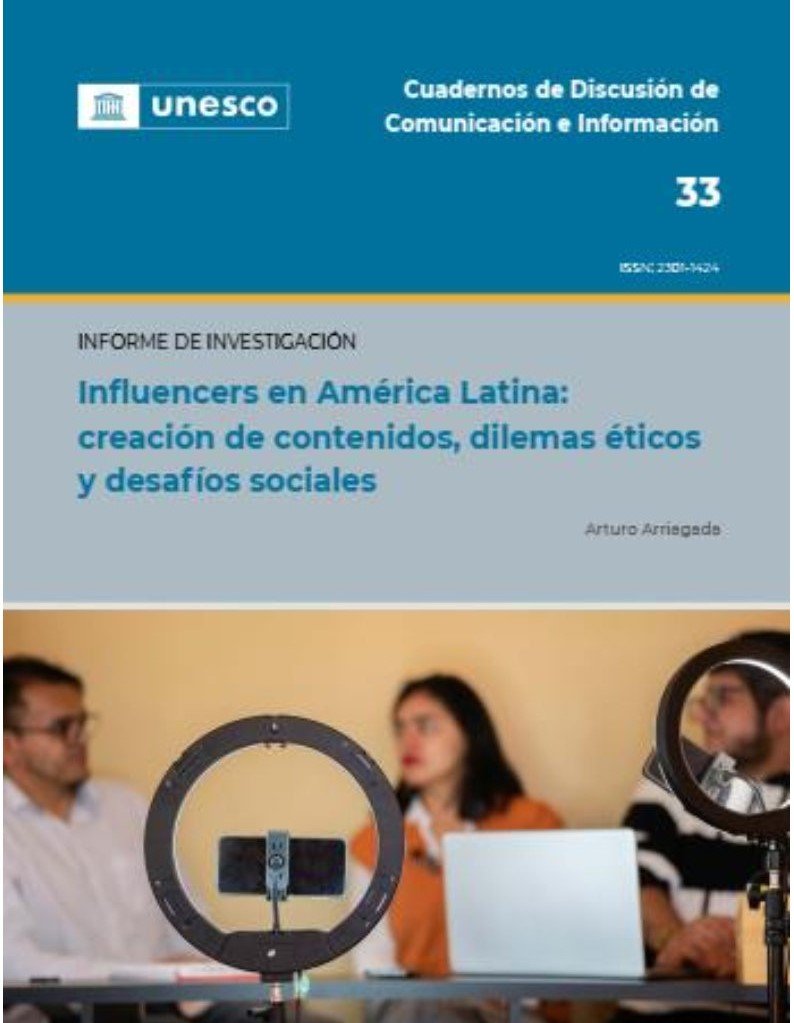
Influencers in Latin America: content creation, ethical dilemmas, and social challenges
Arriagada, Arturo
Presentation and Translation
Media Studies Unit at the Center
The original report consists of 50 pages and was translated from French
—
**Introduction**
This research report was published in 2025 by the United Nations Educational, Scientific and Cultural Organization (UNESCO) and the UNESCO Regional Office in Montevideo. The report was prepared by Arturo Arriagada, in collaboration with a team of researchers from various Latin American countries. The report aims to understand and analyze the dynamics of content creation by influencers in six Latin American countries (Argentina, Brazil, Chile, Colombia, Mexico, Peru), with a particular focus on health and political content, and to identify the ethical, social, and professional challenges they face.
**Context**
The global media and entertainment landscape is undergoing a transformation with the emergence of new actors such as influencers and content creators, who compete with traditional media for audience attention. Globally, the influencer industry is estimated to be worth around $32 billion in 2025, and influencers have become a major source of information on platforms like YouTube, Instagram, and TikTok, sometimes surpassing traditional media.
In Latin America, the situation is similar. By 2023, there were approximately 18.9 million content creators in the region, representing 9% of Instagram users and 3% of the total population. Brazil emerges as the largest market, followed by Mexico and Chile. The report defines influencers as digital content creators on platforms who have a large follower base, a distinctive personal brand, and business relationships with sponsors to promote products and services. They are often seen as entrepreneurs who create cultural and economic value on these platforms.
Influencers’ work is characterized as “ambitious work,” turning passion into income, but often resulting in unstable and unpaid conditions. Influencers also challenge traditional dynamics and knowledge in fields like advertising and media.
Influencers’ impact in the region is multifaceted; they are a primary source of information, especially for young people, and their influence extends to politics—through politicians adopting influencer-like communication styles, influencers entering the political arena, or creating “moral circles” that spread particular political perspectives.
In this context, the report highlights challenges such as a lack of accurate verification processes, where credibility is sometimes measured by popularity rather than accuracy, ethical dilemmas related to non-transparent sponsored content and exposure to hate speech, and ongoing structural inequalities based on gender and race.
**Study Objectives**
The general aim of the study is to understand and compare the ethical challenges and content creation dynamics of influencers in six Latin American countries, and to analyze the values and social representations they promote.
**Specific Objectives**:
1. Analyze influencers’ content creation processes and their relationship with digital platforms, algorithms, and business models.
2. Examine the identities, values, and narratives reflected in their discourse and content.
3. Identify and analyze perceptions regarding ethical challenges and credibility-building in their role as information mediators.
4. Analyze working conditions, collaboration strategies, and perceptions regarding existing regulations and potential legislation for influencer activities.
**Methodology**
The study relied on a qualitative methodology including:
1. **In-depth interviews** with 30 content creators (5 from each country) in health and politics, ensuring diversity in age, gender, and follower count. The sample focused on those who built their audience on digital platforms, not traditional celebrities.
2. **Participant observation** of one influencer’s content from each country for two weeks.
3. **Literature review** and relevant regulatory frameworks.
**Key Findings**
1. **Content Creation Pathways and Personal Profiles**:
The study identified four main types of influencers based on the combination of professional specialization and digital competence:
* **High professional specialization & high digital competence**: Experts with strong academic qualifications and advanced platform skills (common in Argentina, Mexico, and Brazil—especially in health).
* **Low professional specialization & high digital competence**: Skilled digitally without necessarily having strong academic backgrounds (common in Chile and Colombia).
* **High professional specialization & low digital competence**: Experts using platforms complementarily to their main activities without advanced digital strategies (found in Argentina and Peru).
* **Low professional specialization & low digital competence**: Limited influence but able to reach niche audiences (less common).
The COVID-19 pandemic was pivotal for starting or enhancing many influencers’ paths. Academic background also contributes to legitimacy, particularly in health.
2. **Business Models**:
Content creation is not the primary income source for most influencers studied; it is a side job or a “launching platform” to promote main activities (such as medical clinics or consulting) or transition to other media. Platform revenues (like YouTube ads) are often insufficient or unstable, varying by country and audience size. Tensions arise between profitability and authenticity, as many influencers refuse to collaborate with brands that conflict with their values or identity. Larger markets like Brazil and Mexico provide better income, whereas Argentina, Peru, and Chile are characterized by income fragility.
3. **Relationship with Platforms: Algorithms, Metrics, and AI**:
Influencers’ relationship with platforms is marked by dependence and opacity. They must constantly adapt to opaque algorithms that determine content visibility, creating anxiety and fear of reduced exposure. Metrics are used experimentally to understand what works, but they are volatile and may affect mental health. “Algorithmic censorship” of sensitive topics also exists, leading to self-censorship.
AI use is largely optional and exploratory. Some (in Argentina, Chile, Brazil) use it for technical tasks (editing, writing), while others (in Mexico, Peru) avoid it to preserve authenticity. Adapting to algorithms is seen as necessary, while AI integration is a choice.
4. **Relationship with Audiences**:
Influencers seek horizontal, close relationships with followers, using conversational tone and direct interaction (replying to comments, messages, live streams). Interaction style varies by platform, topic, and audience size. In health on Instagram, genuine personal interaction is preferred, while in politics on X (formerly Twitter), caution is dominant due to polarization and hostile discourse. The report emphasizes the emotional burden and pressure to be constantly available to respond.
5. **Digital Violence**:
All influencers studied faced some form of digital violence or hate speech. Political influencers face harsher threats, including death threats in Mexico and Colombia. Women, LGBTQ+ individuals, and racial/ethnic minorities face disproportionate violence, often sexual, racist, or gender-based, targeting appearance or private life. Responses range from ignoring or blocking attacks to official reports or legal action. A complex relationship exists between visibility and digital violence: fame attracts more hate, especially for marginalized groups.
6. **Content Production Processes**:
Motivations vary: politics is driven by activism and issue reporting, health by correcting misinformation or promoting professional services. Influencers rely on sources they consider trustworthy (traditional media, scientific articles), though direct citation is rare in main posts. Platform logic requires simplifying complex information into short videos (60–90 seconds) with clear, appealing language, challenging depth and accuracy. Some influencers train their audience to consume longer content.
7. **Ethical Challenges in Communication and Media**:
Influencers recognize misinformation on platforms and see themselves as responsible for combating it. However, most admit to posting inaccurate information at some point, usually corrected informally (comments or stories). Health influencers emphasize accuracy based on professional expertise, while political influencers adopt a more relative truth perspective, stressing subjectivity and critical thinking. This creates a paradox where promoting critical thinking may undermine trust in scientific consensus in favor of personal experience.
8. **Relationship with Traditional Media and Journalism**:
Influencers see traditional media (TV, radio, newspapers) as separate worlds, considering their appearance there a recognition of importance. They also recognize audiences, especially youth, are increasingly shifting to digital platforms. Some consider themselves a closer, more reliable alternative to traditional media, which they see as losing credibility due to elite dominance or manipulation, and they can simplify complex information more effectively.
9. **Working Conditions and Regulation**:
Content creation is economically unstable. Income depends on algorithm fluctuations, audience size, platform, and country. Platform dependency and continuous production requirements are exhausting. Opinions on regulation differ: many in health see a need for measures to combat misinformation and protect consumers, while some in politics reject influencer-specific regulation due to censorship concerns. There is consensus that current platform controls are insufficient to address issues like misinformation and violence.
10. **Collaboration, Networking, and Training**:
Although content creation is individual by nature, informal networks exist for advice sharing and collaboration. Union or professional association membership is limited and unclear. Platform competition logic hinders solidarity. Influencers value training to improve content quality and visibility, but available programs focus on technical and marketing skills, while ethics training is rare or nonexistent.
**Conclusion**:
The report confirms that content creation in Latin America has become a largely professional and diverse field but faces fundamental challenges. Platforms are opaque, creating instability and anxiety, with direct revenues insufficient for most. Close audience relationships bring emotional burdens and exposure to digital violence, especially for marginalized groups. Ethically, influencers navigate between combating misinformation and the relativity of truth.
**Recommendations**:
* Develop training programs focusing on fact-checking and digital ethics.
* Officially recognize this sector and include it in statistics to understand its size and characteristics.
* Develop regulatory frameworks balancing freedom of expression and practical protection for influencers.
* Strengthen support and solidarity networks among content creators.
* Platforms, governments, and civil society must take a more effective role in combating digital violence and protecting users.
Finally, the report highlights the urgent need for further research and official data on this rapidly growing sector, which has become a major player in Latin America’s media, cultural, and information landscape.
**Original Report Link:** Influencers in Latin America: Content Creation, Ethical Dilemmas, and Social Challenges – UNESCO Digital Library