
Prepared by
Meriam Hssaini
Master’s student in Political Science at Cadi Ayyad University
Research Associate with Hegemoniq Think Tanks
Morocco
Summary
Theoretical background of the research: 6
I Geopolitical Innovation in the Sahel: from Territorial to strategic influence. 10
1 Decentralized Politicization of Borders: Towards Flexible Functional Sovereignty.. 10
2 Managing Strategic Chaos and the Plurality of Confounding Competitors. 12
3 The Political Economy of Fragility: Transforming Threat into Opportunity.. 15
4 Critical challenges and Constraints. 18
II Anatomy of the New Governance Model in the Atlantic Sahel Space. 20
1 Deconstructing a three-pronged geopolitical model 20
2 Operational Mechanisms: Functional Deconstruction and networked reaggregation.. 21
3 Limitations of the study and future recommendations. 23
Amidst the profound geopolitical transformation underway in the Sahel region, the Royal Atlantic Project has emerged in 2023 as a strategic Moroccan initiative aiming to redefine the approach to regional integration by providing Sahel landlocked countries with direct access to the Atlantic Ocean, going beyond the usual institutional approach. This paper aims to discuss this initiative as a case study with a view to examining a new model of leadership and governance in fragile regions, with reference to the redefinition of sovereignty and the management of strategic chaos. The research was based on an integrative methodology that included a qualitative and quantitative approach based on World Trade Organisation data related to intra-regional trade among the core Sahel countries (Mali, Niger, Burkina Faso and Chad) during the years 2020-2024, in addition to an analysis of official documents and reports from international organisations as part of a comprehensive framework. The results revealed three interrelated dimensions: (1) the shift in regional sovereignty towards a functional network sovereignty system through the governance of energy and logistics flows; (2) a multi-centred system of governance through religious, economic, academic and security networks, and (3) the transformation of fragility into an opportunity to establish functional dependency relationships. The paper concludes that the initiative offers an alternative approach to governance, combining practicality and pragmatic flexibility, but its sustainability may be determined by its ability to resolve its internal contradictions regarding its dependence on elites and lack of popular legitimacy, which provides further opportunities for research.
Keywords: Morocco, Post-Sovereignty Space, Anarchic Governance, Royal Atlantic Initiative, Sahel counties.
الملخص
في خضم التحول الجيوسياسي العميق الذي تعيشه منطقة الساحل، ظهر مشروع المبادرة الملكية الأطلسية في عام 2023 كطموح مغربي استراتيجي يهدف إلى إعادة تعريف نهج التكامل الإقليمي من خلال توفير وصول مباشر إلى المحيط الأطلسي للدول غير الساحلية في منطقة الساحل، متجاوزة النهج المؤسسي المعتاد. تهدف هذه الورقة إلى مناقشة هذه المبادرة كدراسة حالة بهدف تحليل نموذج جديد للقيادة والحكم في المناطق الهشة، مع الإشارة إلى إعادة تعريف السيادة وإدارة الفوضى الاستراتيجية. استند البحث إلى نهج تكاملي شمل تحليلاً نوعياً وكمياً استند إلى بيانات منظمة التجارة العالمية المتعلقة بالتجارة داخل المنطقة بين بلدان الساحل الأساسية (مالي والنيجر وبوركينا فاسو وتشاد) خلال الأعوام 2020-2024، بالإضافة إلى تحليل الوثائق والتقارير الرسمية الصادرة عن المنظمات الدولية كجزء من إطار شامل. وكشفت النتائج عن ثلاثة أبعاد مترابطة: (1) التحول في السيادة الإقليمية نحو نظام سيادة شبكي وظيفي من خلال التحكم في تدفقات الطاقة واللوجستيات؛ (2) نظام حوكمة متعدد المراكز من خلال الشبكات الدينية والاقتصادية والأكاديمية والأمنية؛ (3) تحويل الهشاشة إلى فرصة لإقامة علاقات تبعية وظيفية. وتخلص الورقة إلى أن المبادرة تقدم نهجًا بديلاً للحوكمة، يجمع بين الطابع العملي والمرونة البراغماتية، ولكن استدامتها قد تتحدد بقدرتها على حل تناقضاتها الداخلية المتعلقة باعتمادها على النخب وافتقارها إلى الشرعية الشعبية، مما يوفر المزيد من الفرص للبحث.
الكلمات المفتاحية: المغرب، الفضاء ما بعد السيادة، الحكم الفوضوي، المبادرة الملكية الأطلسية، دول الساحل.
The Sahel region is at a turning point, marked by the collapse of traditional systems of governance and the erosion of the Westphalian system of state sovereignty. Institutional weakness, recurrent civil wars and the growing power of non-state actors such as jihadist organisations and transnational criminal networks afflict this vast region that spans the whole of Africa. The situation has been exacerbated by the gradual decline of influence of existing regional institutions, notably the Economic Community of West African States (ECOWAS), from which most Sahel countries withdrew in January 2025. This withdrawal created a power vacuum that destabilised the region and transformed part of the Sahel into a contested zone where the state no longer exercises authority and where external powers, notably Russia and Turkey, are vying for control. Against this backdrop of fragmentation and competition, the inherent problem of stability in the region has shifted from consolidating weak state institutions to managing multidimensional and overlapping spheres of influence within a region where sovereignty is increasingly challenged and a source of conflict.
At the same time, this modern conflict is part of a long historical context of interconnection between North Africa and West Africa. For a thousand years, the Sahel was not a barrier but a bridge, closely linked to vast trade networks with the Maghreb, particularly Morocco. Since the 7th century, caravan routes have facilitated the movement of goods between the empires of Ghana, Mali, Kanem-Bornou and the Maghreb, transporting gold, salt and other commodities. These routes were not only trade routes, they also conveyed ideas, religion and cultural life. The success of Moroccan dynasties in the wider Sahel, particularly the Almoravids and Saadians, played a key role in converting populations to Islam, leaving them with a lasting religious and cultural connection. In the 18th century, Sultan Muhammad ibn Abdullah strategically developed the port of Mogador (Essaouira) to channel trade across the Sahara to the Atlantic Ocean, clearly connecting the interior regions of the Sahel to the world by sea. This system played a decisive role for centuries, with the historic trading centre of Sijilmassa serving as a link or hub. Thus, history has created a legacy of mutual awareness, economic interdependence, and social and religious kinship, which has formed a certain basis for relations between Morocco and the Sahel countries, comparable to the current state of fragmentation in the region.
It is within this dual reality of a serious contemporary crisis and extensive historical ties, that Morocco’s Atlantic Initiative was launched in 2023. This initiative offers an immediate solution to the logistical and geopolitical isolation of the Sahel, namely sovereign access to the Atlantic Ocean via the port of Dakhla for the landlocked countries: Mali, Niger, Burkina Faso and Chad. Although this project is ostensibly an infrastructure project, its importance lies more in its efforts to reopen and modernise the ancient relations between the Maghreb and the Sahel as a stabilising structure in the 21st century. This ambition aims to move beyond failed models of strict state sovereignty and top-down regional integration, enabling functional cooperation based on concrete common interests and historical legitimacy. Thus, the initiative does not appear to be a vacuum, but rather a strategic step to address the contemporary vulnerabilities of the Sahel region in the context of a renewed historical relationship, as an alternative to failing states and the growing intervention of external powers.
The problem of this research lies in the lack of an integrated analytical approach to explain the reshaping of governance patterns and influence in post-sovereign spaces due to the Atlantic Initiative. Previous research has limited itself to studying the initiative as a purely logistical project or as a means of competing in the geopolitical conflict at the regional level, without considering how to analyse the initiative as a complex governmental phenomenon unfolding and emerging in a space of chaos resulting from confusing competition. This lack of analysis allows for the perception of the governance model created by the initiative without any explanation of how the regional actor created and implemented a framework of power and influence that does not correspond to any traditional institution of governance and cooperation, and how to coordinate power relations in hybrid spaces where the state, non-state armed forces and competing international actors coexist, and operate outside the boundaries of traditional regional governance and cooperation systems.
This paper seeks to achieve the following objectives:
- First, to interpret the Atlantic initiative as a theoretical laboratory for formulating a model of anarchic governance in post-sovereign spaces, by decoding its multi-level mechanisms of action.
- Second, to examine how the initiative redefines the concepts of sovereignty and borders by transforming geographical borders into lines of demarcation in spaces of functional cooperation and shifting the role of the state from border guard to flow manager.
- Third, to identify mechanisms for dealing with strategic chaos in the face of multi-level competition (local/regional/international) and the collapse of traditional regional systems.
- Fourth, to analyse the Atlantic Initiative as a theoretical model of governance, and a prospective study examined against the backdrop of a considerable challenges like political fragmentation in the Sahel, The emergence of competing logistics corridors, and pressure from several regional and global rivals.
To comprehend this study, the following questions will be highlighted:
1.What does the Atlantic Initiative entail in terms of a fundamental change in the meaning of sovereignty, namely the establishment of functional sovereignty in border and coastal areas, and how does the project reshape the role of the state not as a border guard but as an engineer of flows in post-sovereign areas?
2.How has the initiative managed to deal with multi-level strategic complexity, such as competition with regional (Algeria) and international (Turkiye, Russia, China) powers, and coexistence with non-state armed groups, following the collapse of traditional regional organisations such as the Economic Community of West African States?
3.To what extent does the chaotic governance model developed by the focuses on pragmatic diplomacy and multipolar networks constitute a viable and sustainable alternative to regional governance in fragile regions? And what will determine its success or failure as an experimental experience in reimagining political organisation in the Global South?
The main importance of this research lies in filling a significant Theoretical gap that lies at the intersection of international relations and geopolitical studies. The main gap is the lack of an integrated theoretical framework for understanding regional initiatives developed in post-sovereign spaces, with the Atlantic Initiative providing a unique case study of a project that creates a pattern of governance out of the chaos of the region. The academic significance of the research is multi-layered: first, it justifies a new theoretical framework consisting of the concepts of post-sovereign space, chaotic governance, and pragmatic diplomacy to explain modern geopolitical phenomena. Second, it helps to formulate the concept of so-called pragmatic geopolitics as an analytical perspective on the dominant ideological concept in this field. Third, it adds content to the debate on other models of regional integration in the Global South by providing a model based not on the Western model of good governance, but on the reality of fragility and opportunity. Fourth, it creates a new methodological openness by adding network analysis and strategic comparison to the understanding of geopolitical complexity.
- Previous peer-reviewed academic literature on the Atlantic Initiative.
The latest peer-reviewed scientific studies on the Atlantic Initiative are a crucial starting point for the study
- Abboubi’s (2024) article, entitled “The Moroccan Proposal for Atlantic Access to the Ocean for Landlocked African Countries”/ « La proposition marocaine d’accès à l’océan pour les pays africains enclavés: analyse des implications politiques et économiques »[1]provides a structured explanation focusing on the legal, economic, and political aspects of the initiative. The theoretical framework underlying this study is the joint integration of theories of international maritime law (which governs the right of landlocked countries to access the sea) and international political economy (which explains the effects of economic integration). The main contribution of the present study is a comprehensive analysis of the possible legal frameworks for implementing the initiative and a preliminary quantitative assessment of its presumed economic benefits for the partner countries. However, it has some shortcomings in that it does not delve deeply into the geopolitical and strategic factors underlying the initiative and the new form of non-traditional governance model it creates, limiting itself to formal and procedural features.
- Nevertheless, in Mariam KERROUCH’s article (2025) “The Atlantic Space: The Stakes and Challenges of an Ambitious Moroccan Initiative”/ “L’espace Atlantique, enjeux et défis pour une ambitieuse initiative Marocaine the Atlantic space, issues and challenges for an ambitious Moroccan initiative”[2], the analytical focus shifts to the Atlantic space as a new geostrategic area linked to the comprehensive change in Moroccan foreign policy and geopolitical orientation. The theoretical framework adopted by the researcher is the theory of geopolitical transformation, in addition to specialised studies on maritime security. The contribution of this paper lies in its multidimensional analysis of the risks of the initiative, particularly in areas such as maritime security in the Atlantic Ocean, securing logistical supply chains, and the possibility of integrating the region with the new platform. However, one of the shortcomings of this work is that it focuses heavily on institutional, logistical and security aspects and does not delve deeply into the theoretical framework, particularly when it comes to covering basic concepts about the nature of change in sovereignty and other alternative forms of governance proposed by the initiative to address regional chaos.
- To be more specific, Ammari and Lyammouri’s (2025) article, entitled “The Atlantic Initiative and Moroccan-Mauritanian Relations”[3] is devoted to examining the initiative’s impact on the restructuring and development of bilateral relations between Morocco and Mauritania. The study is based on a theoretical framework focused on the theory of bilateral international relations and a detailed regional geopolitical analysis. The value of this work lies in its thorough and careful examination of the mutual relations and interests between the two countries within the framework of the initiative, particularly cross-border trade, security cooperation and energy projects, making this paper a rich bilateral analysis in the broader context of the regional initiative. However, the main weakness of this strategy is that it is not geographically broad, covering only the bilateral aspect and neglecting a comprehensive analysis of the multilateral governance model established by the initiative with a number of countries, as well as a comparative analysis of its tactics in dealing with other actors in the region.
- The novelty and uniqueness of the study compared to previous studies and theories
This study is an important contribution and an advanced link of the Atlantic Initiative research series. However, while other researchers, such as Abboubi (2024), KERROUCH (2025) and Ammari and Lyammouri (2025), were limited to the analysis of a specific lens of the initiative’s dimensions (legal, economic, logistical, or bilateral) and applying them within traditional theoretical frameworks, this study goes beyond that and elevates the level of analysis from applied description to strategic theorising. It does not view the initiative as merely a development or cooperation project, but treats it as a “living theoretical laboratory” for creating a new model of governance in post-sovereign spaces.
An element that has not been explored in depth in previous studies is the paradigm shift in concepts of sovereignty and power inherent in the initiative. These studies have discussed access to the Atlantic Ocean or economic integration, but have not addressed how the initiative transforms borders into dividing lines for functional areas of cooperation, or how it exercises functional sovereignty based not on territory but on flows of management (energy, data, and commodities). Furthermore, they did not delve deeply into analysing the multi-centred, non-hierarchical model of governance established by the initiative, through parallel religious, economic, academic and security networks, as a practical response to the failure of traditional regional models.
Theoretically, unlike previous studies that used existing theories (such as international law, political economy, and bilateral relations), this study presented a new and complex conceptual framework for the post-sovereignty space, non-hierarchical governance, and multi-level pragmatic diplomacy. This framework not only explains the initiative, but also provides analytical tools for understanding similar phenomena in fragile regions around the world. Thus, the research aims to fill a knowledge gap in analysis, not only in explaining what the initiative does, but also in how it reshapes geopolitics and why this model represents a different way of doing things in an era of declining traditional sovereignties.
Theoretical background of the research:
This paper presents a complex three-dimensional theoretical approach to analysing the Atlantic Initiative. it goes beyond current partial theories and proposes a comprehensive explanatory model to explain the dynamics of governance in post-sovereign spaces. This model is based on three interrelated concepts that constitute a new analytical perspective:
- Post-sovereign space
This concept describes the geopolitical terrain in which the Atlantic Initiative exists, a terrain marked by the loss of the traditional Western model of the nation state: weak state authority, the power of non-state armed groups, the power of regional and international forces, and the power of cross-border economic and religious networks. Sovereignty, in this case, is not a homogeneous and indivisible entity; it is a fluid and fragmented condition. The Initiative operates not despite this political ‘chaos’, but because of it and within it. The absence of central authority will create a vacuum that the Initiative will fill by providing alternative sovereign services.
- Functional network sovereignty
This is the basic idea formulated by the study to describe the initiative’s mechanism of action. It examines how territorial sovereignty (control over land) could be transformed into functional sovereignty (influence over functions). This sovereignty could be achieved by influencing four key flows: logistical flows through the port of Dakhla and land corridors, energy flows through the gas pipeline project, security flows through training and equipment programmes, and symbolic-cognitive flows through religious and higher education. Importantly, this functional transition will be achieved not through traditional state institutions, but through an integrated system of actors: the Moroccan state (as planner and guarantor), private companies (as operators), religious and educational institutions (as designers), and local partner elites (as mediators and implementers). In this way, the regional character of the concept of sovereignty is removed, but it is based on practical need and utility.
- Decentralised, multi-centred governance
This term describes the administrative model developed by this new type of sovereignty. The word “decentralised” does not mean chaos, but rather the structure of the working environment, in which there is no single accepted central authority. In turn, the initiative builds a multi-centred system of governance, forming a number of specialised and somewhat independent poles (centres): the religious centre (the Institute of Imams), the economic centre (the investment network), the security centre (training and consulting), and the academic centre (universities and scholarships). Strategic coordination between these centres is carried out through the decision-centre in Rabat, but they enjoy considerable freedom of movement in their dealings with local populations and elites. This structure provides existential flexibility that enables the model to continue to function in the event of a failure of official diplomatic channels of communication, as all channels of communication exist through clerics, businesspeople and graduates.
These three terms do not operate separately, but form a dynamic cycle: the post-sovereign space generates influence and opportunity; then the initiative develops functional network sovereignty to expand the Moroccan power by managing critical operations; this in turn creates a model of multi-centered chaotic governance that can survive in such a complex environment. These keys form a theoretical framework that can explain not only the case of the Atlantic Initiative, but also discuss similar emerging patterns of governance in weak spaces globally, where traditional patterns of statehood or institutional integration can no longer be used to provide viable solutions.
The analyses in the proposed study focus on three interrelated variables and identify the Atlantic initiative as one model for managing post-sovereign spaces.
- Independent variable: post-sovereign space
This comprises a geopolitical landscape characterised by the loss of state authority, the presence of multiple actors (states, armed groups, private companies) and the absence of central authority. This creates a governance vacuum in which the provision of services and security become key sources of influence. This is a prerequisite for initiative operations.
- The intermediate variable: anarchic governance mechanisms
This epitomizes the specific tools that the initiative uses to operate in the environment described above: dividing labour between states (e.g. logistics or security) and distributing it among specialised networks; creating alliances of interest with any useful actor; and redefining borders as areas of cooperation rather than boundaries.
- Dependent variable: Sustainability of the alternative model
This is the main outcome analysed, and it embodies the sustainability of the initiative’s governance model, which is measured by its resilience to face crises such as wars or armed conflicts, by its credibility gained through local acceptance, and by its ability to redefine regional geopolitics by establishing new alliances and connections in the framework of win-win cooperation.
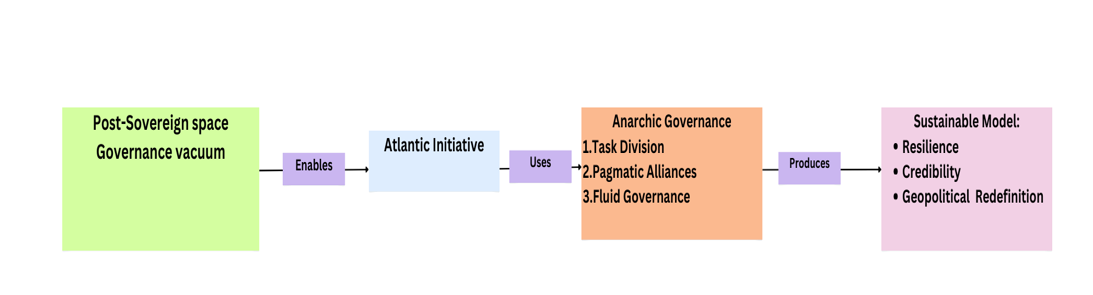
Figure 1 Conceptual Model; Source: Author Analysis
The novelty of this conceptual framework is epitomized in containing a specific and verifiable causal chai, which links the spatial condition of the post-sovereign space to the strategic application of anarchic governance mechanisms, which in turn determine the sustainability of a different model. This takes the analysis a step further than explaining how fragile environments produce new functional governance structures and whether they can be sustained. As well as providing a new analytical tool that can be applied to similar situations around the world.
This paper follows an integrated research approach combining empirical quantitative analysis and strategic qualitative analysis, in the context of a detailed case study of the Atlantic Initiative. The paper focuses solely on material data and quantitative indicators and does not discuss the rhetoric of political texts. Then it is important to highlights that the data used and results reflects a prospective analysis , which focus more on actual results that could influence future trends and dynamics.
- Quantitative section (empirical analysis)
This section seeks to track patterns and trends in economic and material variables related to the development of the initiative by examining two main sets of data.
First, it describes international trade statistics provided by the World Trade Organisation (WTO) on bilateral trade between Morocco and the main Sahel countries (Mali, Niger, Burkina Faso and Chad) during the period 2020-2024, with a focus on exports, imports, the evolution of the trade balance in bilateral trade, and the level of relative dependence in bilateral trade.
Second, the quantitative institutional processing of the initiative’s results, including figures on the number of military personnel and officers from Sahel countries trained in Morocco (source: Ministry of Defence), the number of African students from Sahel countries studying in Moroccan universities (source: Moroccan Agency for International Cooperation), the number of graduates from the Mohammed VI Institute for the Training of Imams, and the application of World Bank reports on transport and logistics costs in the region. This quantitative examination provides quantifiable measures of the growing economic and human ties between Morocco and the Sahel countries in relation to the initiative.
- Qualitative component (strategic and structural analysis)
The task of this component is to describe the mechanisms and strategies of the quantitative data structure with the help of three main analytical tools based on reports and secondary sources.
- Structural analysis of physical projects as geopolitical tools: in this case, the strategic design, location and capacity of the West Africa Free Zone (WAFZ) in Dakhla are examined, and the geopolitical implications of the route and capacity of the Nigeria-Morocco gas pipeline project are considered.
- Analysis of non-state actor networks: This is done by tracking the pattern and spread of direct investments by major Moroccan companies in the areas of banking, telecommunications, and the construction of capitals and cities in the Sahel countries, as well as the structure of religious networks established by the Institute of Imams.
- Evaluation of the comparative model: This includes comparing the governance model designed by the initiative with the traditional institutional model of the Economic Community of West African States (ECOWAS) in terms of flexibility and effectiveness, and the models of influence of competing international powers in the Sahel region, including Russia’s model based on security, and Turkiye’s model based on Islamic nationalism.
- Integration and verification: the process of systematically triangulating and verifying the results is carried out methodically. Trends observed in quantitative data (increased trade or demographic data) are compared with the associated qualitative analysis (development of economic networks or strategic infrastructure projects) in order to develop a coherent and logical explanatory narrative. All of this is done in line with observable measurable results and phenomena that go beyond political rhetoric. Generally, this methodology increases the objectivity of the results, reduces the importance of interpretative bias, and provides strong empirical support for analysing the initiative as a multifaceted geopolitical phenomenon.
This study is organized into two major sections in order to dissect the innovative aspects of the Atlantic Initiative of Morocco in the Sahel systematically. First, it examines the general theoretical basis of Geopolitical Innovation: of Territorial to Sovereignty of Influence. This is done by a tripartite analysis (1) The Decentralized Politicization of Borders and the move towards a model of flexible, functional sovereignty that redefines state control over spaces and flows; (2) The Management of Strategic Chaos and the Plurality of Competitors, whether jihadist, regional or global forces, in an environment of eroded state power; and (3) The Political Economy of Fragility, i.e. how the Initiative attempts to transform structural vulnerabilities and threats into strategic opportunities and geopolitical capital. Second, the paper extends this paradigm to provide an Anatomy of the New Governance Model in the Atlantic Sahel Space, disaggregating the multi-actor, multi-level networks that include religious, economic, security, and diplomatic channels through which such a novel mode of influence-based sovereignty is acted out and reproduced, and finally assessing whether this new model of regional order makes sense and is viable.
I Geopolitical Innovation in the Sahel: from Territorial to strategic influence
In this part the study explores the Atlantic Initiative of Morocco as an innovative example of geopolitical adjustment. Instead of seeking the traditional territorial control, the Initiative signifies an advanced redefinition of statecraft; the shift towards no longer controlling the land, but the leverage of functions, networks, and flows within the porous Sahelian space. This paper analyses the functioning of the Initiative that creates what it refers to “functional sovereignty”, which copes with complex multi-actor environments and the way structural vulnerability can be redesigned into geopolitical capital, suggesting a novel form of regional engagement by dismantling the paradigm of IR.
The results of the analysis show that the concept and practice of sovereignty in the Sahel region has shifted from a “Westphalian model” based on alleged exclusivity and the control of geographical borders, to a flexible and “Functional” model based on redefining borders as spaces for flow and cooperation. This is not merely a tactical change, but a long-term strategic plan that transcends the political rigidity of geographical borders, particularly between Morocco and Algeria, and between the Sahara and the Sahel. This functional sovereignty stems from a focus on regulating vital functions, including the flow of goods, energy and data, rather than controlling territory, demonstrating a deep understanding of the nature of power in the 21st century, where the management of networks and flows has become as important as the control over territory.
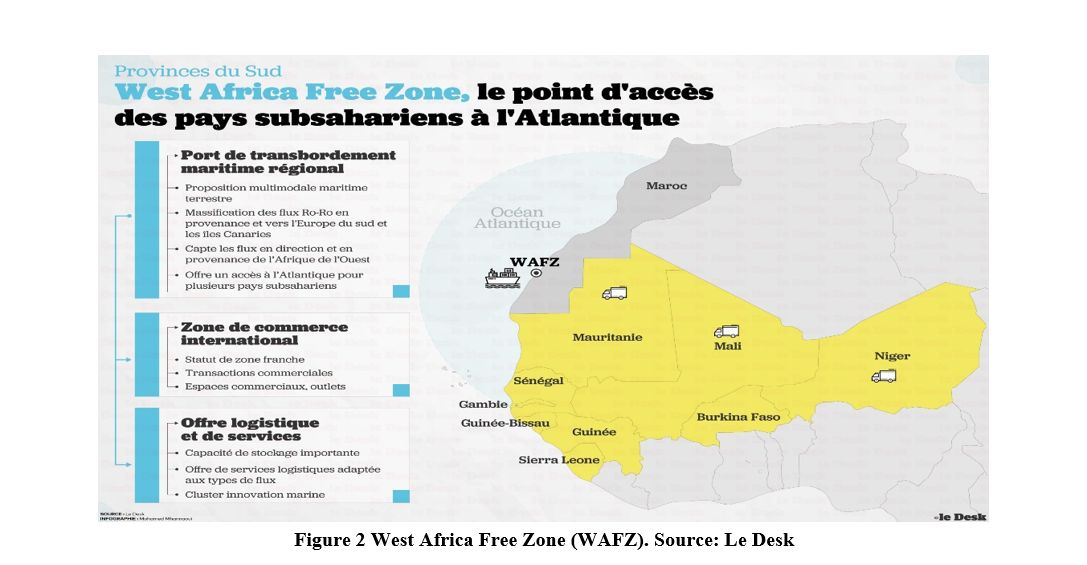
This vision is clearly reflected in the 45 hectares West Africa Free Zone (WAFZ) in Dakhla[4]. Thus, rather than engaging in a sterile border war, the initiative attempts to establish logistical sovereignty, achieved through seizing key vital corridors and infrastructure. This port is not expected to be merely a place that receives ships, but is also intended to be a space for unifying the economic landscape in the region. So, it is through this logic that strategic priority has been given to the 5,600-kilometre gas pipeline project between Nigeria and Morocco. This project with a cost of $25 billion, represents not just an economic investment, but it is a multifaceted geopolitical tool that will change the energy distribution map in the region. Thus, thanks to this pipeline, Morocco will transform itself from an energy consumer into a centre of energy management and distribution, establishing a new reality in which traditional sovereignty over territory becomes secondary to real orchestration of the flow of a strategic resource[5].
This functional sovereignty is reinforced by the creation of a network of forward functional nodes in the Sahel regions. The spread of Moroccan economic groups in key sectors, such as Attijariwafa Bank, Maroc Telecom, along with an investment of 34 billion CFA francs in the cement industry in Burkina Faso, doesn’t epitomize a traditional commercial expansion, rather, it constitutes the creation of small centres of Moroccan influence that enjoy a kind of administrative and economic sovereignty over areas that are legally subject to the sovereignty of partner countries. These nodes play a role of active cells within the body of host countries that generate structural dependencies which make cooperation with Morocco an economic necessity than a political choice. Conversely, the limits of Moroccan influence can now be determined by the spread and impact of these networks, rather than by lines drawn on a map. This shift from spatial sovereignty to networked one is a pragmatic way of dealing with the fact that the Sahel has always been a complex reality, where rigid borders are no longer effective in countering cross-border threats, while functional cooperation networks are more efficient in addressing the challenges they all face.
This results in three interrelated models of sovereignty describing the initiative as shown in figure 3, which dissects that the success of the initiative does not depend on imposing the first (traditional) model, but rather on establishing new realities based on the second and third models: functional sovereignty, which establishes practical subordination, and shared sovereignty, which takes into account the complex nature of power in the Sahel region. This plurality in the exercise of sovereignty can be described as a form of polycentric governance, in which the central state (Morocco) does not dominate, but rather organises and coordinates a network of functional centres and sub-networks spread across the neighbouring region. These centres are semi-autonomous, but they are aligned with an overarching strategy that provides flexibility and adaptability to local complexities.
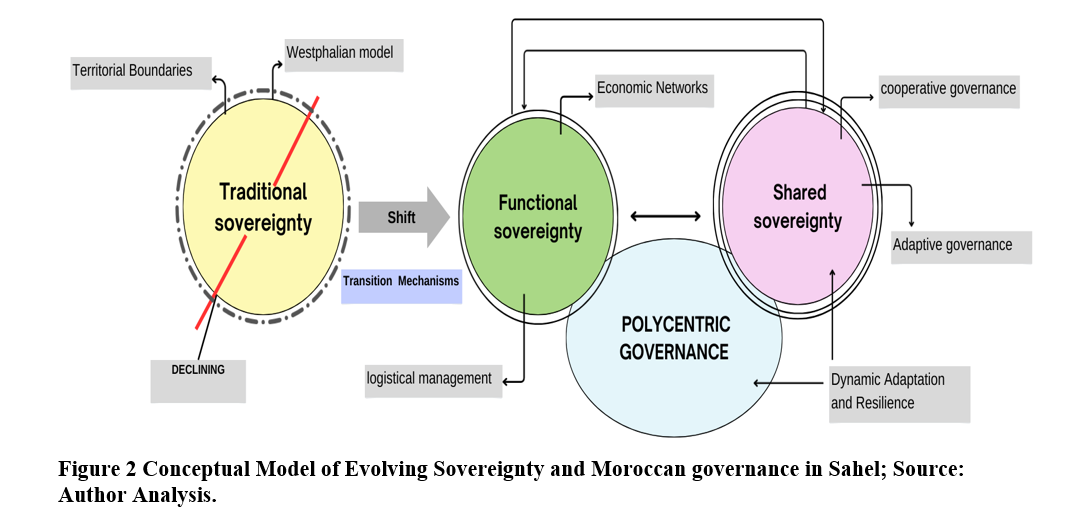
This model represents a gradual shift towards sovereignty, as its initial stage, the traditional Westphalian system, which entails the cornerstone of exclusive territorial influence, is not deliberately pursued as a practical goal. The second phase is the strategic driving force of the initiative: functional sovereignty. This phase works by creating tangible physical links, pipelines, ports, banking networks and digital communications, reconnecting the region. They are not only economic projects, but also geopolitical projects that create permanent practical dependencies where the basis of authority is no longer based on legal claims but on operational necessity. At the same time, the model offers a third phase: shared sovereignty, which provides the desired political and legal model, which recognizes the fragmented state of power in the Sahel, where communities and international actors share power. This phase reconceptualizes governance as a multi-stakeholder, negotiated process, rather than an hegemonic system.
The most important interaction is the synergistic between the second and third stages, which embodies a new concrete reality of interdependence resulting from functional projects, this leads to a polycentric and shared governance that facilitate diplomatic and political language to deal with different changes. This starts from a decentralized system of semi-autonomous hubs and alliances, to achieve a high level of regional integration through adaptable coordination and mutual interests rather than hegemony.
An examination of the initiative’s interactions with its geopolitical environment shows that it has a great capacity to deal with what can be called “strategic chaos” due to the multiplicity and diversity of competitors and threats in the Sahel region. Rather than pursuing a monolithic approach, the initiative takes a multifaceted and differentiated approach to dealing with the challenge of overlapping layers of competition: between traditional regional powers (Algeria), new international actors (Turkiye, Russia, and China), and non-state armed actors.
In competing with the Algerian government, the initiative uses a strategy of “geopolitical circumvention”. It does not directly engage in the issue of sovereignty in the Sahara, but rather attempts to rewrite the rules of the game by establishing new economic and logistical realities. This is done by making Morocco a desirable hub for landlocked Sahelian countries (Mali, Niger, Burkina Faso), thereby reducing these countries’ dependence on Algerian ports and weakening Algeria’s traditional negotiating position. The creation of a logistical and economic phenomenon represented by the dependence of countries on the port of Dakhla is a kind of indirect economic warfare aimed at stripping the classic border dispute of its strategic essence and transforming it from a conflict over land into a conflict over service provision.
The initiative is highly flexible, with a selective strategy of coexistence and assimilation in dealing with new international players such as Turkiye and Russia. Studies show that Morocco does not compete directly with the Russian security-military model or the Turkish Islamist-nationalist model. Instead, it participates in complementary alliances across other sectors. While these powers are concerned with security and military dimensions (with arms contracts and mercenaries), Morocco is interested in creating a lasting economic infrastructure and networks of civil elites. Over time, this silent division of labour may transform the initiative into a real competitor, a partner in the eyes of these cynical powers, each filling a separate gap in the weak Sahel landscape. This political economy of conflict work is a profound appreciation of civil infrastructure policies and investment in education in the region, a long-term bet that may prove more successful than replaceable security solutions.
This is based on the existence of a complex network of non-state actors, which, through collective utility, create a system of chaotic regional governance as mentioned in Figure (4). The model shows that the initiative develops a multi-layered fabric of influence with each network, approaching a different layer of Sahelian societies. This pluralism generates strategic immunity, that despite cold formal relations, there are always open lines of influence through clerics, economists, graduates and officers, which is the spirit of multi-level pragmatic diplomacy.
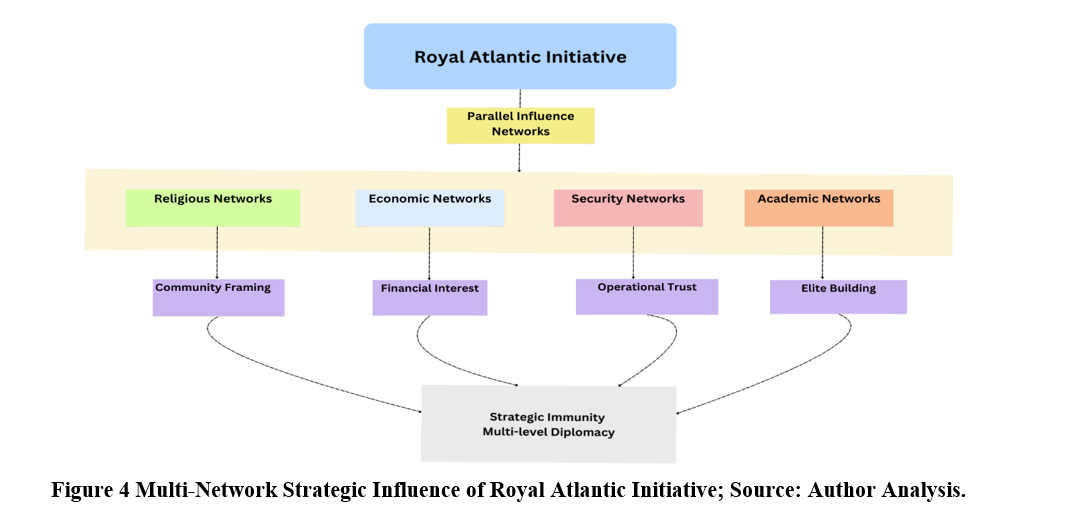
According to the model of the four interconnected networks, the Atlantic Initiative can be seen as the construction of a measurable and resilient parallel governance system in the Sahel. This system does not work by substituting the formal sovereignty of the state; It is internalized in the structural points of weaknesses of states, creating a self-reinforcing system of influence based on solid data. The strength of the initiative lies in the fact that the four main networks of the initiative are strategically linked and overlapping, and each of them is empirically measurable:
- The Religious Network offers social legitimacy at a deep level, and the basis of this legitimacy is the Mohammed VI Institute for the Training of Imams, which trained 2,798 graduates in nine African countries between 2015 and 2022, with over 400 Malian imams in January 2025[6].
- The Economic Network generates dependencies and physical interests. This is manifested in the fact that, since 2009, Bank Attijariwafa has expanded to five countries, Maroc Telecom coordinated telecommunications in four countries, and direct investments such as 34 billion CFA francs in Burkina Faso’s cement industry by groups such as CIMAF.
- The Security Network is based on the establishment of trust and interoperability in operation. At the end of 2024, According to Abdeltif Loudyi, the Minister Delegate in charge of the National Defense Administration, that as of the end of September 2024, the Royal Armed Forces have trained 1,205 foreign officers and non-commissioned officers, mainly from African countries. Similarly, the Royal Gendarmerie centers have welcomed 300 officers for basic or continuing training, entirely supported by the Kingdom.
- The Academic Network is betting on future elites. The total number of beneficiaries of Moroccan academic scholarship programs has increased to 19,000 with a 31,000 as a total number of graduates. Along with that, it should be noted that in 2025, Morocco awarded 5,410 scholarships to students from 46 African countries as revealed by Morocco’s ambassador to the African Union, Mohamed Arrouchi.
These together reflect organic interactions which form a fabric of opinion influence; starting with a community that is influenced by Moroccan imams (Network 1), and in a community where Moroccan bank operates (Network 2), followed by military officials (Network 3) that gains strategic influence over a trade route, trained in Moroccan Universities (Network 4). This forms a closed-loop ecosystem, in which the religious framework, financial interests, operational capacity, and intellectual alignment are all self-imposing.
The result is a kind of strategic immunity, which is also decentralised, multidimensional, rooted in social and institutional fabric of partner states, making it difficult to counter it through traditional methods. Subsequently, the Royal Atlantic Initiative creates a long-term Morocco-based governance subsystem that relies on its networks and synergies, operating in parallel and increasingly defining formal political systems in the Sahel.
As can be analysed, the initiative relies on its ability to manoeuvre within the political economy of fragility in the Sahel region. The initiative did not view fragility as an obstacle, but rather as a strategic opportunity for geopolitical reconfiguration, taking advantage of the relative decline of traditional actors such as France and the Economic Community of West African States. This approach is based on the premise that fragility creates a need for alternative services. In a context of state failure, the initiative presents itself as a reliable provider of essential services, which is why it invests simultaneously in areas that appear different but are strategically linked: military training (to build trust and strengthen capacities), energy (to create strategic dependence), logistics (to restructure flows) and education (to ensure intergenerational sustainability).
This is already being implemented through a comprehensive and targeted economic policy where Morocco, as a state, is no longer perceived as a trader but as the main investor and operator of the main economic infrastructure of the Sahel. The project implements a calculated roadmap to leverage key sectors:
- Banking and financial systems: To establish itself at the centre of the Sahel’s financial fabric, since 2009, Attijariwafa Bank has been expanding to key economies such as Côte d’Ivoire, Senegal, Gabon, Mali and Cameroon with governance of key points in the capital, credit and trade flow.
- Telecommunications and digital networks: To take over the key connectivity industry, Maroc Telecom acquires major shares in the African telecommunications networks of Burkina Faso, Gabon and Mali, giving Morocco decisive influence of digital infrastructure, data traffic and future technological integration.
- Strategic industrial and infrastructure management: To consolidate Moroccan capital in fundamental areas of development, direct investments of companies such as Ynna Holding and Omnium Nord-Africain (ONA) including direct investments in Burkina Faso’s cement industry were expanded in Sahel countries. Moreover, National organizations such as the CCGT and ONEP have also make significant contributions to large-scale infrastructure development in Senegal, Guinea, and Cameroon, along with a collaboration between Royal Air Maroc and CEMAC which reshapes local airline in Mali, Niger, Gabon, and Guinea, extending its influence to major air transport chains.
- Trade dominance and asymmetric integration: This is an investment surge that is reflected in Morocco’s dominant commercial position. Trade between ECOWAS and the country increased by an average of 13.1% between 2008 and 2016, with Moroccan exports tripling their initial level of 2.8 billion dirhams to 8.5 billion dirhams. In 2016, half of Morocco’s trade with sub-Saharan Africa was represented by ECOWAS, with Senegal (1.9 billion dirhams), Côte d’Ivoire (1.4 billion) and Nigeria (1.4 billion) being the most important partners. Such trade relations remain very asymmetrical because the level of ECOWAS imports was not very high; in 2016, it amounted to about 1 billion dirhams, which confirms a large and growing trade surplus of Morocco[7].
The long-term goal of this targeted multi-sectoral approach is to make the economic sustainability, connectivity and development path of the Sahelian states functional to Moroccan capital, infrastructure and trade platforms. The Atlantic Initiative can enable the region to establish a strong, non-coercive type of leverage, based on the consistent provision of key economic services in situations where few other competitive options exist. This economic entanglement is the material support of the broader geopolitical agenda of building the reoriented and Moroccan-based regional subsystem.
There is an interesting development in this regard, as economic data indicate. Analysis of trade exchange between Morocco and core Sahel countries (Mali, Burkina Faso, Niger, Tchad) shows (Table1) a significant structural change, namely a significant shift to expand the economic influence.
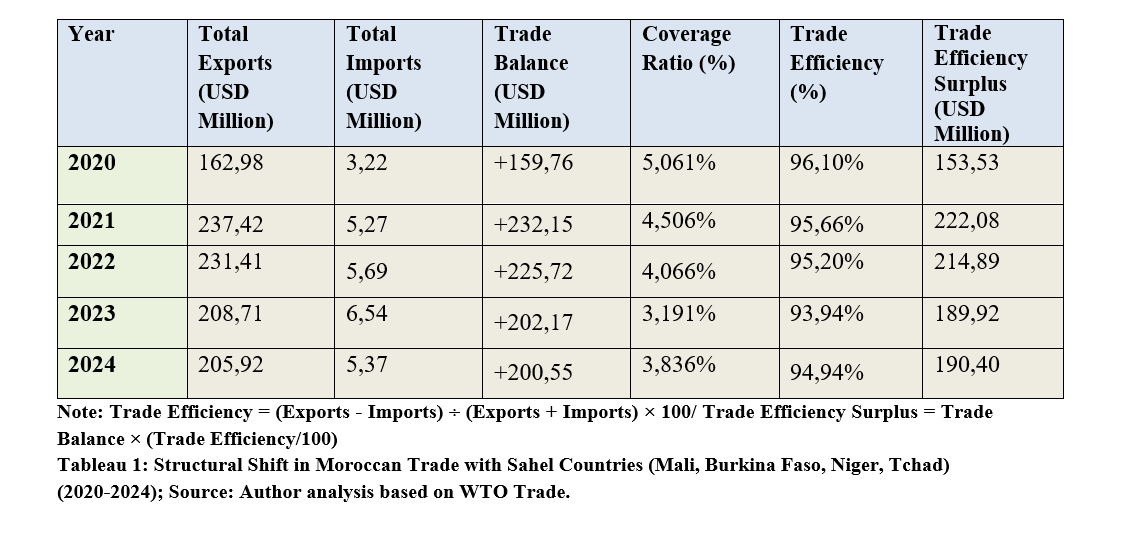
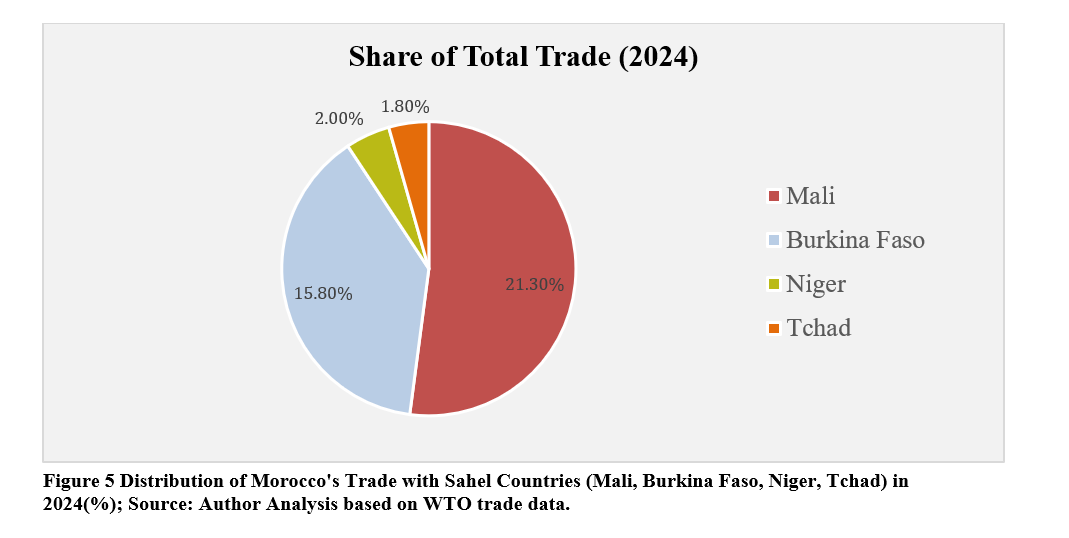
Figure 5 Distribution of Morocco’s Trade with Sahel Countries (Mali, Burkina Faso, Niger, Tchad) in 2024(%); Source: Author Analysis based on WTO trade data.
The data presented in the table1 and Figure 5 testify Morocco’s strategic transformation of fragility into a sustainable partnership. The 2024 data, which show exports of $205,92 million to Sahel countries against minimum imports of $5,37million, reflect an economic relationship based on reliability and critical support. Far from indicating mere dependence, this constant trade emphasizes a total efficiency surplus of $970,82 million from 2020 to 2024 demonstrating a stable and resilient trading system where Morocco acts as a guarantor of vital supplies such as fertilizers, refined fuels, and food products. This role directly strengthens food security and economic continuity in partner countries, turning trade into a tool for solidarity and mutual resilience.
This trade structure is deeply rooted in non-economic capital: historical ties, religious kinship, and diplomatic trust built up over decades. Moroccan exports, especially in critical sectors such as fertilizers, have thus become more than raw materials that represent an instrument of cooperative security and development support. The remarkable stability of trade efficiency, even in the face of regional instability, underscores how Morocco’s diplomatic, commercial, and social networks function as a shared safety network, mitigating risks and fostering continuity. This model of “network risk sharing” allows engagement to flourish even in fragile environments, turning potential vulnerability into a platform for sustainable cooperation.
From a political and economic perspective, this approach aligns perfectly with Morocco’s Royal Atlantic Initiative, which aims to foster stability through economic integration and strategic partnership. By concentrating trade along the Atlantic corridor Mali alone accounts for 21.30% of Sahelian trade, which reflect the ability of Morocco in strengthening maritime and economic connectivity, promoting regional security, and positioning itself as a reliable player in a complex geopolitical landscape.
In this respect, rather than viewing the Sahel through the lens of threat, Morocco is building mutual interests and structural interdependence, using trade and investment to promote long-term stability and turn regional challenges into opportunities for shared growth and integration.
In summary, Morocco’s commercial engagement with the Sahel exemplifies a forward-looking model of economic diplomacy one that leverages historical ties, human capital, and strategic diplomacy to build resilient partnerships, strengthen regional security, and transform fragility into the foundation of sustainable development.
The Sahelian states (Mali, Niger, Burkina Faso, Chad) face a deep and intertwined complex of structural and strategic problems that go far beyond the traditional interpretation of economic weakness. With analysis, such challenges constitute a self-reinforcing web of vulnerabilities that leads to a condition of chronic structural precariousness. With already difficult economic times, these countries are experiencing:
- Existential logistics and connectivity deficits: The region experiences a chronic lack of negative connection in the region. Comprehensive and integrated corridors connecting landlocked states are sorely lacking. Even the already existing arteries, such as the trans-Saharan highway, are not yet completed, only some parts, such as the link between Algeria and Tamanrasset, are paved. This lack of infrastructure not only paralyzes the movement of goods, but also causes the cost of transport to explode to unbearable levels. Bases on World Bank Data the average cost of transport in Africa is 11.4% of the cost of trade compared to 6.8% in developed countries. A delay of one day during transit can add a value of 0.8 to the final value of the goods. In West Africa, transport costs can account for more than one-third of the export value (up to 45% of imports), and at 2.43 per kilometre, double the cost of the United States[8]. This is a fundamental obstacle to economic integration and competitiveness.
- Complex and interlocking security crises: This area is in a vortex of instability that goes beyond the terrorist threat. The region suffers from deep institutional weakness, aggravated by military coups, successive coups d’état (as observed in Mali, Burkina Faso and Niger). These uprisings weaken the power of the state, especially in remote and border areas that become safe havens for armed groups such as AQIM, JNIM and the Islamic State of the Greater Sahara. This instability leads to a massive movement of people and makes border security difficult. In addition, the adjacent Atlantic front is seeing an increase in illegal acts (piracy, illegal fishing, arms trafficking, drugs and migrants), especially in the Gulf of Guinea, which is generally considered one of the dangers for commercial shipping due to the lack of resource sharing and cooperation between coastal countries (patrol boats, radars).
- Environmental and climate existential threats: The region’s destructive climate has accelerated. The Intergovernmental Panel on Climate Change (IPCC) has projected a temperature rise in the Sahel of at least +2°C by 2021-2040, 1.5 times higher than the global rate[9]. The result is an increase and dramatic climate change (droughts, floods, desertification) that deteriorates already fragile infrastructure and has adverse effects on the health of the most vulnerable groups (women, youth, nomads). More importantly, this environmental deterioration is a disastrous feedback loop with insecurity: lack of resources fuels conflict, lack of stability prevents the realization of the climate adaptation project, and the region is locked in a spiral of increasing vulnerability.
- Extensive regional and international geopolitical competition: This is a multi-pronged competitive pressure environment in which the initiative operates.
- Regional rivalry: It competes with regional powers such as Algeria (which has no Atlantic coastline and is against Moroccan influence) and with established regional blocs such as ECOWAS, especially due to the current crisis at the time of the withdrawal of various Sahelian states.
- Growing global competition: The initiative competes with the offensive behavior of powers such as China under its Belt and Road Initiative, investing in large-scale infrastructure development (ports, roads, telecommunications) to acquire economic and political resources. In the same vein, Turkey and Russia are also competing as they increase their presence in Africa and Russia through the use of private military companies such as Wagner. This rivalry can divide the loyalties of the Sahelian states and diminish the strategic space in which the Moroccan initiative will operate.
- Ongoing and evolving security threats: Continued terrorist attacks and general instability in the Sahel pose a direct challenge to any infrastructure project. The suggested logistics routes (especially land routes) would be prone to attack, high insurance and operating costs, making them unmanageable, making them economically unaffordable unless secured by them. In addition, the lack of strong control by central governments over their own territories leads to a security vacuum filled by armed groups and traffickers, making it more difficult to secure trade routes.
- Sustainable strategic transformation: Morocco has successfully transformed its traditional trade relations into a model of smart trade dominance, where huge trade surpluses are used to exert geopolitical influence.
- Multiplicity of tools: the initiative has combined both soft tools (training, education and investment) and hard tools (trade, energy and security) to create a system of mutual but asymmetrical interdependence (network).
- Organic interdependence between the economy and geopolitics: high trade surpluses (averaging +494.40 million/year) have broader mutual benefits, and Morocco provides strategic resources in the form of important raw materials in exchange for diplomatic and security clout.
- Institutional resilience: the initiative has achieved high levels of trade efficiency despite changes in the region, demonstrating the high degree of resilience of the Moroccan model and its ability to respond to a fragile context especially during Covid -19 lockdown.
- Structural Challenges in the Network model: despite multiple multi-network design of the Initiative, it is also facing several systemic risks including environmental and logistical constraints, sovereignty dilemma of partner states, emergence of external powers, and security threats.
II Anatomy of the New Governance Model in the Atlantic Sahel Space
This study presents a detailed analysis revealing various aspects of the Royal Atlantic Initiative, which offers an unprecedented strategic response to structural problems in the Sahel region. The findings indicate that the initiative is not merely economic or logistical, but rather an innovative geopolitical model for redefining sovereignty and governance in a fragile region. As analysed, the initiative operates on the basis of a three-pronged, interrelated logic: the first aspect is to replace the rigid, sieve-like model of territorial sovereignty, which has been mired in the Saharan conflict, with a functional and interconnected model of sovereignty. In this model, territorial sovereignty over land is replaced by sovereignty over government flows: gas flows through a virtual pipeline between Nigeria and Morocco (5,600 km long), goods flow through the port of Dakhla on the Atlantic Ocean, capital flows through Moroccan investment networks in banking and telecommunications, and even knowledge and dedication flow through academic and religious networks. This last aspect is the ability to develop a multi-centred governance system capable of dealing with the strategic chaos in the Sahel region. Instead, the initiative has created four parallel and interconnected networks of power, including a religious network (the Institute of Imams and its 2,798 graduates between 2015-2022)[10], an economic network (the penetration of Moroccan companies into infrastructure sectors), an academic network (with 5,410 African students and scholarships available in 2025), and a security network (training 1,205 foreign military personnel). The third and most audacious aspect is the transformation of a fragile political economy not only into a strategic resource but into an existential threat. The initiative creates deep functional dependency by establishing itself as a reliable source of essential sovereign services (logistics, security, energy, education) in a market where none exist. This change is no longer just theoretical, but is tangibly reflected in economic indicators, with the trade balance with sub-Saharan Africa shifting from a deficit of MAD 6,804 million in 2010 to a surplus of MAD 6,994 million in 2017, with the coverage ratio increasing to 146.3% over the same period and from MAD 346.53 million of exportations in 2020, to MAD 507.45 million in 2024 from Morocco to Sahel countries.
This initial tactical success can be explained by deciphering the dual mechanism underlying the initiative’s design. The first mechanism is the functional deconstruction of the conflict: In this case, the underlying geopolitical conflict (between Morocco and Algeria over the Sahara) is not treated as an unbreakable block that must be overcome with military or diplomatic force, but rather broken down into a system of contested functions: access to the sea, management of roads, and stategic influence over resources. By targeting these two elements the port of Dakhla and the pipeline project the initiative offers a viable alternative solution, particularly with regard to these functions, for the non-coastal states of the Sahel region, thereby transforming the conflict in the region from a struggle over a symbol (land) to a struggle over the provision of a service (function). The second mechanism is network regrouping with a centralised command mechanism. Once the jobs have been dismantled, the initiative does not leave them to chaos, but re-organises their management within a network, with its planning and financing centre located in Rabat, and allows for the broad participation of local and international actors in its work. For this reason, significant investment has been made in both physical infrastructure (which generates need and dependence) and human infrastructure (which generates loyalty and operational capacity). The end result is the construction of a sophisticated strategic ecosystem, in which the Sahel countries are linked within a set of interests and destinies, with decision options that are not imposed by force, but rather through functional utility and managed interdependence.
This mechanism has a number of profound implications. First, it leads to a shift in the geopolitical priorities of partner countries. Issues such as access to the sea through an efficient and secure port, or access to energy and food through a capable supplier, may exceed their practical agenda more than ideological allegiances or unconventional alliances. Second, it leads to a shift in the balance of power among local elites in the Sahel countries. The elites’ relationships with Moroccan networks (economic, through investments; religious, through the institute; security, through training; academic, through scholarships, etc.) take on new weight and interests, which could gradually restructure internal forces in favour of those who are aligned with this project. Third, it creates a different formula for risks and profits. The insecurity and environmental impact in the Sahel region, previously seen as an obstacle to traditional investment, has been restructured in the logic of the initiative to become a factor that concentrates geopolitical profits. The more sensitive and less substitutable the services provided by the sovereign are, the greater the value of the services provided by the initiative and the greater its bargaining power.
The focus on the Atlantic initiative places the findings in deep dialogue with broad theoretical trends in international relations, allowing them to be placed on an intellectual map of the field. On the one hand, the research is fully consistent with post-Westphalian currents and the thesis of fragmented sovereignty in particular. According to Steven Krasner’s formulation, sovereignty is not a unified block, but a set of rights (legal sovereignty, domestic sovereignty, international sovereignty, recognition sovereignty) that can be separated and exercised unevenly[11]. An excellent practical version of this concept can be found in the Atlantic Initiative. It effectively bypasses the search for full sovereignty over disputed territories and goes beyond the complex issue of legal sovereignty, developing instead a functional sovereignty of a practical nature with regard to flows and processes. It shows how a state can dominate a gas pipeline that passes through several countries, or a logistics network that can serve as a vital artery for other countries, without necessarily having traditional control over the territories through which these networks pass. This intersection demonstrates the importance of the fragmented sovereignty model in understanding modern dynamics, particularly in border and fragile regions.
Conversely, the results reveal a clear weakness in classical realist theory, particularly the central premise that hard power (military and coercive economic power) is the sole or even primary source of international power. Conventional realist logic would dictate that a project of this magnitude undertaken by Morocco in a competitive region such as the Sahel should be countered by a military show of force or diplomatic sanctions. However, the initiative reveals that influence can be developed through long-term investment in the infrastructure of structural soft power. Training imams is not only a form of soft power propaganda, but also a form of investment in the religious infrastructure of the target communities. Hosting students is not a humanitarian gesture, but rather a kind of investment in the intellectual infrastructure of future elites. Thus, the model presented by the initiative broadens the concept of power to include the ability to build and coordinate the complex systems needed by other parties, which in an era of complex interdependence may be more decisive than the ability to destroy systems which aligns systematically with Joseph Niye soft power lens[12].
Finally, the results contradict the idealistic views of liberal theory of regional integration[13]. The liberal model represented by the European Union (for example) assumes that integration is based on shared values and institutions (democracy, human rights, and the rule of law) and, through supranational institutions, encourages parties to be bound by common rules. The Atlantic initiative offers a starkly pragmatic alternative to this model. It freely colludes with overt military regimes that do not believe in liberal democratic ideals. It does not create a new supranational institution, but operates within a network of bilateral agreements and selective partnerships. This points to a second, practical and non-ideological path to integration that may be more appropriate in environments where there is no homogeneity of values or where the institution is not trusted. This integration continues to recognise fragility and hostility as a key reality and develops limited functional cooperation around it, without deluding itself that it can be overcome by political unity.
This theoretical analysis has some important implications at several levels. Theoretically, this study contributes practically to the field of study by introducing and embodying the concept of functional network sovereignty as a theoretical construct for analysing the issue. This idea allows us to understand how states, particularly ambitious middle powers, overcome traditional geographical constraints and exercise their strategic influence without engaging in costly existential conflicts. The concept of pragmatic geopolitics presented in the context of the study also represents a contribution to the field of critical geopolitical studies because it avoids allegiance to a single ideological camp (West/East, democracy/autocracy) and chooses to use the logic of interests and opportunities when dealing with any party, regardless of the type of ruling regime. This idea could be key to explaining the behaviour of a growing number of states in the multipolar international system.
In practical and applied terms, the findings offer important lessons for a number of actors. In the case of the Moroccan policymaker, the study shows that the success of the initiative will be determined by his ability to deal with the central contradiction between the initiative’s tactical effectiveness in establishing functional dependency relationships and the need to develop sustainable popular legitimacy in partner countries. This requires the creation of tools to measure and promote the project’s tangible developmental contribution to the lives of ordinary citizens in the Sahel region, not just the ruling and economic elites. In the absence of this, functional dependency can become a source of popular discontent, and structural soft power can become a political liability. In the case of the partner countries in the Sahel region, the study provides a framework for understanding the risks and opportunities. The prospects lie in the provision of ready-made sovereign services and the connection of their economies to global markets. The risk lies in the fact that states are slowly being deprived of their strategic role and are becoming countries that hire external services, with all that this entails in terms of weakening their independent political and economic decisions. Finally, for traditional regional and international organisations operating in the Sahel (such as the African Union, the European Union or the United Nations), the findings suggest that traditional forms of intervention (political mediation, peacekeeping missions, conditional development aid) may be subject to radical review. The initiative shows that incentives can be more effective than coercion, and that practical and viable alternatives can be more stable than calls for mere political change. This requires consideration of hybrid forms of cooperation between values and institutions on the one hand, and pragmatism and efficiency on the other.
this study is subject to several methodological and fundamental limitations that have directly affected the depth and comprehensiveness of the analysis. First, the analysis is limited to the period 2020–2024, which is also the period during which the initiative was announced and designed, but not actually implemented, and has not yet been evaluated in subsequent studies. Second, the use of official Moroccan documents, reports from international organisations and media reports leads to a potential bias in the narrative, as it was difficult to access systematic and critical local perspectives from Sahel countries and independent assessments of operational risks. Third, the initiative also operates in a highly complex environment in which several political, security, economic and environmental factors interact. Fourth, the study confirmed the ongoing of the actual political and security conditions, despite the Sahel region is known for its volatile dynamics. Thus, a number of geopolitical impact assessments are based hypotheses awaiting verification through longitudinal data from the implementation phase.
At this regard, the study suggests considerable future research avenues to enhance the study and recommendations:
- Monitoring social research on community impact: As the initiative moves to a broader level of field deployment, it is necessary to initiate in-depth social and anthropological research in the communities directly affected (around the port of Dakhla, along the planned roads and corridors, in the areas of agricultural or energy projects). These studies aim to identify local perceptions of benefits and risks, how projects will affect traditional social structures and local power relations, and the potential for new forms of discontent and resistance within the community. This is the only way to answer an important question: will economic and logistical efficiency translate into social and political legitimacy?
- Methodological comparison with ‘fragil models’ in other regions: A systematic analytical comparison will be proposed between the strategies of other countries that have had to deal with fragile neighbours or conflict zones, in order to determine the degree of uniqueness or generalisability of the Moroccan model. What is Turkiye’s policy towards northern Syria and Libya? What are the United Arab Emirates and Saudi Arabia doing towards Yemen? How does Iran deal with Iraq? This comparison will indicate whether the Moroccan initiative is a unique case or a more widespread geopolitical phenomenon of powerful states in the centre engaging with neighbouring regions in turmoil.
- Analysing the Political and economic of investment sustainability and risks: A project of this size and ambition requires huge financial inflows and dealing with investment risks that did not exist before.
- Analysing the interaction between environmental security and human security in the context of major infrastructure projects: by studying the implications of the Atlantic Initiative requires a multidisciplinary approach capable of linking extreme climate factors (as predicted in the Intergovernmental Panel on Climate Change report) and the socio-economic vulnerability of local populations. This study could examine the impact of accelerated environmental change, including the projected +2°C temperature rise by 2040, on the viability and sustainability of logistics corridors, as well as how to improve infrastructure to make communities more resilient to climate and security shocks. This approach is not technical, but human and developmental.
- The Atlantic Initiative has policy implications as follows:
To transform the Initiative into a viable solution to the stability of the region, several political orientations can be identified:
- In the case of Morocco: Add functional relationships with the community by operating at the social level and creating social legitimacy outside of elite ties.
- In the case of Sahelian states: Use collective bargaining to create coherence that would support sovereign autonomy while providing maximum return to development.
- In the case of regional organizations (AU, ECOWAS): institutionalize the Initiative to integrate the Initiative into African standards of governance and conflict resolution systems.
- In the case of international partners (EU, UN): Sustainability and human security aspects of the model: support through blended finance and conflict-sensitive investments.
The success of the Initiative will ultimately be determined by its ability to convert infrastructure connectivity into inclusive development, so that its governance model is not seen as an external source of leverage but as a common regional future.
This paper addressed the fundamental question of whether the Atlantic Initiative is capable of building a new model of sovereignty and governance in the Sahel, a region characterised by the destabilisation of traditional forms of statehood and the emergence of chaotic areas where different actors and levels of influence interact. The main question was how a medium-sized force initiative could rewrite the geopolitical rules of the game in such a multipolar environment.
The most important findings point to some transformative dynamics. First, the initiative is building a model of functional sovereignty, focusing on the management of strategic, logistical, security, economic and religious flows, rather than traditional territorial control. Second, the initiative operates within a multi-contract governance system that includes the state, religious institutions, companies, security agencies and academic framework in a hybrid structure that cannot be interpreted in the traditional hierarchical manner. Third, the initiative relies on its effectiveness through flexible pragmatic diplomacy that includes all actors, including governments and armed units, and is based on practical interests rather than ideology. Fourth, the initiative embodies a strategic investment in institutional capital in unstable environments, exploiting structural weaknesses as an opportunity to reshape the geopolitical situation.
The implications of these findings are significant. Theoretically, this study offers a new paradigm for understanding the sovereignty revolution of the 21st century, one that challenges classic formulations of state/anarchy and formal/informal governance. In practical terms, it provides a flexible model for other regions of the world suffering from state weakness, such as Yemen, Somalia and Afghanistan, as an alternative to traditional interventionist strategies. At the political level, this model promotes cooperation between countries of the South around a vision of functional integration rather than bureaucratic institutions.
To concludes, the Atlantic Initiative is, in essence, a project that goes beyond traditional development project or economic expansion. It can be seen as an experimental redefinition of sovereignty in the twenty-first century. Given the increasing interconnectedness of the regional, local, and global space and the presence of both formal and informal actors, the initiative fosters a flexible and dynamic framework that will be relevant in the face of the shocks of modern geopolitical dynamics. Its ultimate measure of success or failure will not be limited to the destination of the Sahel, but will have a broader impact on how policies are structured in the future through networks in which states are now managing flows, border guards, and contracts in a complex interactive system. In this regard, the Royal Atlantic Initiative is not only an expression of Moroccan foreign policy, but also a future perspective of a world in progress.
Abboubi, Bouchta El. “La proposition marocaine d’accès à l’océan pour les pays africains enclavés : analyse des implications politiques et économiques.” Revue Internationale du Chercheur 5, no. 2 (June 1, 2024). https://revuechercheur.com/index.php/home/article/view/953.
Abdessalam Saad Jaldi. “Artificial Intelligence Revolution in Africa: Economic Opportunities and Legal Challenges.” Policy Center, 2023. https://www.policycenter.ma/publications/artificial-intelligence-revolution-africa-economic-opportunities-and-legal-challenges.
Abitbol, Michel. “Le Maroc et le commerce transsaharien du XVIIe au début du XIXe siècle.,” 1980. doi:10.3406/remmm.1980.1887.
Albano, Orazio. “Ten Things You Need to Know about the New Port of Dakhla Atlantique in Morocco.” Blue Life Hub, January 11, 2024. https://www.bluelifehub.com/2024/01/11/ten-things-you-need-to-know-about-the-new-port-of-dakhla-atlantique-in-morocco/.
Ammari, Fadoua, and Rida Lyammouri. “THE ATLANTIC INITIATIVE AND MOROCCO– MAURITANIA RELATIONS:,” August 2025. https://www.policycenter.ma/sites/default/files/2025-09/RP_09-25%20%28Rida%20Lyammouri%20%26%20Fadoua%20Ammari%29%20EN.pdf.
Andersson, Hans E. “Liberal Intergovernmentalism, Spillover and Supranational Immigration Policy.” Cooperation and Conflict 51, no. 1 (2016): 38–54. https://www.jstor.org/stable/48512876.
APA-Bamako (Mali). “Morocco to Train 400 New Malian Imams, Deepening Religious Cooperation.” APAnews – African Press Agency, July 10, 2025. https://apanews.net/morocco-to-train-400-new-malian-imams-deepening-religious-cooperation/.
atalayar. “Morocco’s Atlantic Initiative Will Transform Africa’s Geostrategic Landscape,” 2024. https://www.atalayar.com/en/articulo/politics/moroccos-atlantic-initiative-will-transform-africas-geostrategic-landscape/20240308110000197607.html.
Baylocq, Cédric, and Aziz Hlaoua. “Diffuser un « islam du juste milieu » ?: Les nouvelles ambitions de la diplomatie religieuse africaine du Maroc.” Afrique contemporaine n° 257, no. 1 (January 19, 2017): 113–28. doi:10.3917/afco.257.0113.
dakhlainvest. “Dakhla Invest – West Africa Free Zone,” June 6, 2025. https://www.dakhlainvest.com/projet-wafz.html.
Devillard, A., Bacchi, A., & Noack, M. “A Survey on Migration Policies in West Africa | IOM Publications Platform,” 2015. https://publications.iom.int/books/survey-migration-policies-west-africa.
Elhabnouny, Mohammed, Salma Oudrhiri, Youssef Menchafou, Driss Zejli, and Aouatif Saad. “Wind Energy Integration in Desalination: A Public-Private Partnership Approach to Addressing Water Scarcity in Dakhla, Morocco.” Scientific African 29 (September 1, 2025): e02814. doi:10.1016/j.sciaf.2025.e02814.
en.unav.edu. “Morocco Aims to Become the Regional Leader the Sahel Needs. Global Affairs. University of Navarra,” 2024. https://en.unav.edu/web/global-affairs/marruecos-pretende-convertirse-en-el-lider-regional-que-necesita-el-sahel.
fm6oa. “L’Institut Mohammed VI de Formation des Imams Mourchidine et Mourchidat: Fiche d’Information.” FONDATION MOHAMMED VI DES OULEMA AFRICAINS, 2015. https://www.fm6oa.org/fr/linstitut-mohammed-vi-pour-la-formation-des-imams-morchidines-et-morchidates-fiche-dinformation/.
Holsti, K. J. “Stephen D. Krasner, Sovereignty: Organized Hypocrisy, Princeton: Princeton University Press, 1999.” Japanese Journal of Political Science 1, no. 1 (May 2000): 157–72. doi:10.1017/S1468109900210189.
Joseph S. Nye, Jr. “Soft Power on JSTOR,” 1990. https://www.jstor.org/stable/1148580.
Kalmo, Hent, and Quentin Skinner, eds. Sovereignty in Fragments: The Past, Present and Future of a Contested Concept. Cambridge: Cambridge University Press, 2010. doi:10.1017/CBO9780511675928.
Krasner, Stephen D. “Abiding Sovereignty.” International Political Science Review / Revue Internationale de Science Politique 22, no. 3 (2001): 229–51. https://www.jstor.org/stable/1601484.
Lauret, Alexandre, and Mathieu Mérino. “L’Afrique face aux mutations stratégiques.” Revue Défense Nationale n° 882, no. 8 (2025): 232. https://shs.cairn.info/revue-defense-nationale-2025-8?lang=fr.
le Desk. “Façade Atlantique Du Sahara: Des Chantiers Pour Matérialiser l’ambition Du Maroc – Le Desk,” 2023. https://ledesk.ma/datadesk/facade-atlantique-du-sahara-des-chantiers-pour-materialiser-lambition-du-maroc/.
Lyammouri, Rida. “POLITICAL ECONOMY ANALYSIS AND CONFLICT ANALYSIS,” May 2025. https://www.policycenter.ma/sites/default/files/2025-06/RP_04-25%20%28Rida%20Lyammouri%29.pdf.
Lyammouri, Rida, and Amine Ghoulidi. “MOROCCO’S ATLANTIC INITIATIVE: A CATALYST FOR SAHEL-SAHARAN INTEGRATION,” 2024. https://www.policycenter.ma/sites/default/files/2024-12/PB_68-24_Rida%20Lyammouri.pdf.
maghress. “Maghress : Le Gazoduc Nigeria–Maroc de 25 Milliards de Dollars Avance Avec La Création d’une Société de Projet et l’appui d’institutions Financières Internationales,” 2025. https://www.maghress.com/fr/barlamanefr/460050.
Mariam KERROUCH. “L’espace Atlantique, Enjeux et Défis Pour Une Ambitieuse Initiative Marocaine | International Journal of Accounting Finance Auditing Management and Economics,” 2025. https://revue.ijafame.com/index.php/home/article/view/1508.
maroc.ma. “Ambassador Hilale Highlights Royal Atlantic Initiative’s Role in Sahel Countries’ Development | Maroc.Ma,” 2025. https://www.maroc.ma/en/news/ambassador-hilale-highlights-royal-atlantic-initiatives-role-sahel-countries-development.
———. “Foreign Ministers Hail Morocco’s Leadership in Advancing Atlantic African States Process | Maroc.Ma,” 2025. https://www.maroc.ma/en/news/foreign-ministers-hail-moroccos-leadership-advancing-atlantic-african-states-process.
———. “HM the King Delivers Speech to Nation on Occasion of 48th Anniversary of Green March (Full Text) | Maroc.Ma,” 2023. https://www.maroc.ma/en/royal-speeches-and-messages/royal-speeches/hm-king-delivers-speech-nation-occasion-48th-anniversary-green-march-full-text.
———. “Morocco’s Royal Atlantic Initiative Highlighted in N’Djamena | Maroc.Ma,” 2025. https://www.maroc.ma/en/news/moroccos-royal-atlantic-initiative-highlighted-ndjamena.
———. “Royal Atlantic Initiative Highlighted at 2nd Africa-CARICOM Summit | Maroc.Ma,” 2025. https://www.maroc.ma/en/news/royal-atlantic-initiative-highlighted-2nd-africa-caricom-summit.
Masson-Delmotte, Valérie, and Panmao Zhai. “Rapport spécial du GIEC sur les conséquences d’un réchauffement planétaire de 1,5 °C,” 2019. https://www.ipcc.ch/site/assets/uploads/sites/2/2019/09/SR15_Summary_Volume_french.pdf.
Organization, World Trade. “WTO Tariff and Trade Data – Official Global Trade Database.” Accessed January 3, 2026. https://ttd.wto.org/en.
Patricia Ahanda. “Maroc : Leader Pivot Du Sud Global – Au Cœur Des Recompositions Africaines, Atlantiques et Multilatérales,” 2025. https://www.policycenter.ma/publications/maroc-leader-pivot-du-sud-global-au-coeur-des-recompositions-africaines-atlantiques-et.
Revue Défense Nationale. “L’Afrique Face Aux Mutations Stratégiques.” SHS Cairn.Info, 2025. https://shs.cairn.info/revue-defense-nationale-2025-8.
Université Internationale de Rabat. “Afrique(s) En Mouvement 2024/3 (N° 9).” SHS Cairn.Info, 2025. https://shs.cairn.info/revue-afrique-en-mouvement-2024-3.
voaafrica. “Mauritanian Defense Minister Arrives in Mali to Ease Tensions,” 2023. https://www.voaafrica.com/a/mauritanian-defense-minister-arrives-in-mali-to-ease-tensions/7578776.html.
Yousra Abourabi a; Julien Durand de Sanctis. “The Royal Atlantic Initiative: A Manifestation of African Agency in Regional Integration? | Cairn.Info,” 2025. https://shs.cairn.info/revue-afrique-en-mouvement-2024-3-page-18?lang=en.
“Zotero | Your Personal Research Assistant.” Accessed January 12, 2026. https://www.zotero.org/download/.
التوزاني, حكيم. “الدبلوماسية القنصلية بالأقاليم الجنوبية للمملكة المغربية: مقتضيات الارتكاز وآليات التحليل وآفاق الاستشراف.” المجلة الالكترونية للدراسات القانونية والتنمية, no. العدد الأول (May 22, 2023). https://revues.imist.ma/index.php/REEJD/article/view/40318.
د.محمد اصفريو. “المقاربة المغربية المتعددة الأبعاد في تدبير المعضلة الأمنية بمنطقة الساحل: آليات توطيد السلام وبناء الأمن.” مجلة شؤون استراتيجية, 2023. https://journal-strategic.com/2023/03/09/602/.
[1] Bouchta El Abboubi, “La proposition marocaine d’accès à l’océan pour les pays africains enclavés : analyse des implications politiques et économiques,” Revue Internationale du Chercheur 5, no. 2 (June 1, 2024), https://revuechercheur.com/index.php/home/article/view/953.
[2] Mariam KERROUCH, “L’espace Atlantique, Enjeux et Défis Pour Une Ambitieuse Initiative Marocaine | International Journal of Accounting Finance Auditing Management and Economics,” 2025, https://revue.ijafame.com/index.php/home/article/view/1508.
[3] Fadoua Ammari and Rida Lyammouri, “THE ATLANTIC INITIATIVE AND MOROCCO– MAURITANIA RELATIONS:,” August 2025, https://www.policycenter.ma/sites/default/files/2025-09/RP_09-25%20%28Rida%20Lyammouri%20%26%20Fadoua%20Ammari%29%20EN.pdf.
[4] dakhlainvest, “Dakhla Invest – West Africa Free Zone,” June 6, 2025, https://www.dakhlainvest.com/projet-wafz.html.
[5] maghress, “Maghress : Le Gazoduc Nigeria–Maroc de 25 Milliards de Dollars Avance Avec La Création d’une Société de Projet et l’appui d’institutions Financières Internationales,” 2025, https://www.maghress.com/fr/barlamanefr/460050.
[6] APA-Bamako (Mali), “Morocco to Train 400 New Malian Imams, Deepening Religious Cooperation,” APAnews – African Press Agency, July 10, 2025, https://apanews.net/morocco-to-train-400-new-malian-imams-deepening-religious-cooperation/.
[7] “Diffusion_Etude_CEDEAO.Pdf,” accessed May 31, 2025, https://www.oc.gov.ma/sites/default/files/2018-05/Diffusion_Etude_CEDEAO.pdf.
[8] “Etude_sur_les_couts_et_delais_de_transport_des_marchandises_vf_-_cbc.Pdf,” accessed June 5, 2025, http://cns.bf/IMG/pdf/etude_sur_les_couts_et_delais_de_transport_des_marchandises_vf_-_cbc.pdf.
[9] Valérie Masson-Delmotte and Panmao Zhai, “Rapport spécial du GIEC sur les conséquences d’un réchauffement planétaire de 1,5 °C,” 2019, https://www.ipcc.ch/site/assets/uploads/sites/2/2019/09/SR15_Summary_Volume_french.pdf.
[10] fm6oa, “L’Institut Mohammed VI de Formation des Imams Mourchidine et Mourchidat: Fiche d’Information,” FONDATION MOHAMMED VI DES OULEMA AFRICAINS, 2015, https://www.fm6oa.org/fr/linstitut-mohammed-vi-pour-la-formation-des-imams-morchidines-et-morchidates-fiche-dinformation/.
[11] Stephen D. Krasner, “Abiding Sovereignty,” International Political Science Review / Revue Internationale de Science Politique 22, no. 3 (2001): 229–51, https://www.jstor.org/stable/1601484.
[12] Joseph S. Nye, Jr., “Soft Power on JSTOR,” 1990, https://www.jstor.org/stable/1148580.
[13] Hans E Andersson, “Liberal Intergovernmentalism, Spillover and Supranational Immigration Policy,” Cooperation and Conflict 51, no. 1 (2016): 38–54, https://www.jstor.org/stable/48512876.


