


Prepared by
Meriam Hssaini
Master’s student in Political Science at Cadi Ayyad University
Research Associate with Hegemoniq Think Tanks
Morocco
Executive Summary
The fast expansion of submarine cables infrastructure has become a major factor in Africa’s digital transformation, and is basically the main way through which the continent carries international data. This development emerges as a driver for geopolitical competition where China, by its strategic involvement in the most important projects, is challenging the set technological and security paradigms of the West. This study aims to examine the way African states react to the soft power influence of China and geopolitical rivalry. It seeks to plot an interaction of the technological strategy of China, represented by a well-integrated digital ecosystem, and security-driven strategies of the West. The analysis concludes that China is gaining influence through comprehensive, large-scale bundled digital offerings, and that African countries need to focus on diversified partnerships, improved local connectivity, and strong national regulatory frameworks to ensure their digital sovereignty and resilience in the long term.
Keywords: Africa, China, Digital Silk Road, Soft Power, Submarine cables infrastructures.
Introduction
The rapid expansion of submarine cable infrastructure is really changing the digital landscape of Africa completely, or rather, it is roaring the whole continent’s interaction with global information flows. The landing stations being built at major places such as South Africa, Nigeria, and Djibouti, among others, is a very important turning point for the international data that is passing through the undersea fibers, which is over 95%. The US, China, and the EU, in particular, have started to consider these cables as strategic means of gaining influence, getting economic benefit, and aligning with others in terms of security, rather than being neutral commercial assets. Engagement of China with the PEACE and 2Africa projects is increasingly being seen within its broader Global Security Initiative (GSI) (Ministry of Foreign Affairs of the People’s Republic of China, 2023); thus, Beijing is using a powerful combination of state-backed financing, monopoly of the market, and control over digital chokepoints to create long-term influence through the consolidation of the market. The installation of the cable infrastructure directly paves the way for the following deployment of sophisticated technologies like 5G and cloud computing, thus becoming a foundational layer for both tech upgrade and maneuvering, which in turn makes the governance of African policymakers more complex.
Hence, the main goal of the study is to analyze the manner in which China, as a global power, uses submarine cable projects as soft power tools to influence Africa’s digital infrastructure and governance models. The inquiry is thereby narrowed down to a central question: How does China employ submarine cable infrastructure as a soft power resource to extend its influence in Africa, and how does this strategy define its rivalry with other world powers, the US and Europe, in terms of influence? Two short and interconnected points organize the analysis structure: the first axis analyses geopolitical rivalry of submarine cables in Africa and strategic influence of China, while the second axis examines both technological duality and strategic functions, while the third axis epitomizes a SWOT analysis to dissect different strategic consequences of Submarine cables expansion. All these aspects together make a coherent model through which one can easily perceive the powers that are determining the digital future of the continent.
- Strategic Dynamics and Geopolitical Competition
2.1. China’s soft power strategic integration on Africa’s Submarine Cables
Africa undoubtedly ranks among the leading global growth markets, powered by digital transformation that is made possible by a resurgence of economic progress. Currently, the continent is equipped with 77 submarine cables, which not only provide international connectivity but also create links for the major digital hubs in Africa with those in Europe, Asia, and the Americas. Out of the 54 African countries acknowledged by the United Nations, 38 have seacoasts, and 37 of them have at least one submarine cable landing, except for Eritrea which is isolated in this respect. The whole system of cables acts as a highway for international data flow and at the same time it provides internet, cloud services, and digital platforms access for hundreds of millions of African internet users. The distribution of cable landing points is not uniform: at the end of 2019, 11 coastal countries each had a single cable, 10 countries had two, six had three, and 10 countries had more than three, distributed especially across Egypt, Morocco, Nigeria, Kenya, South Africa, and Senegal.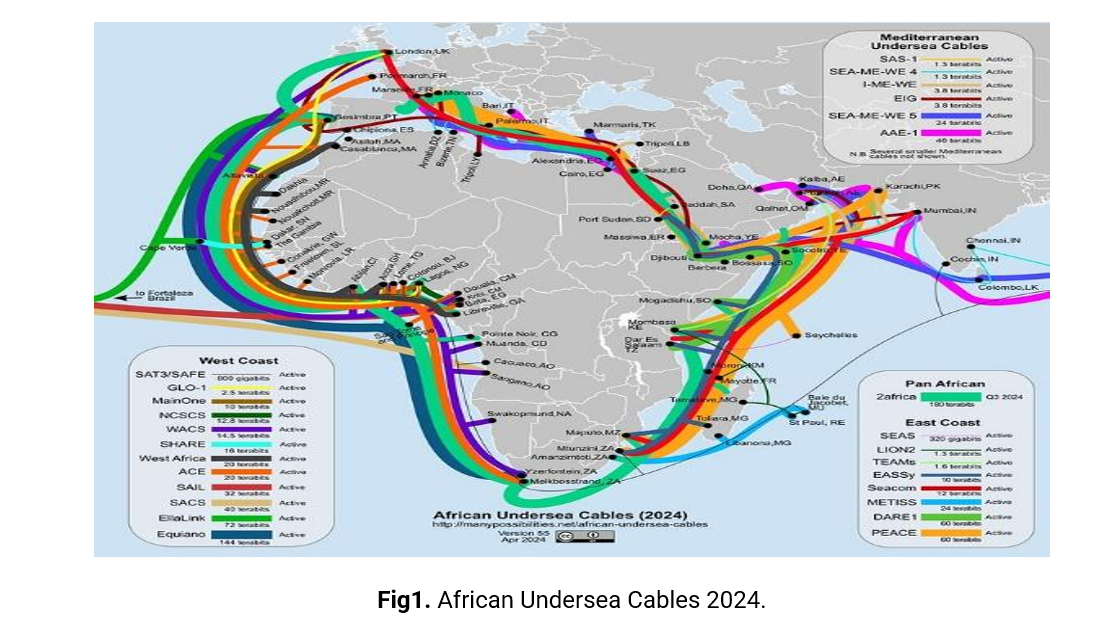
Source: submarinenetworks.com
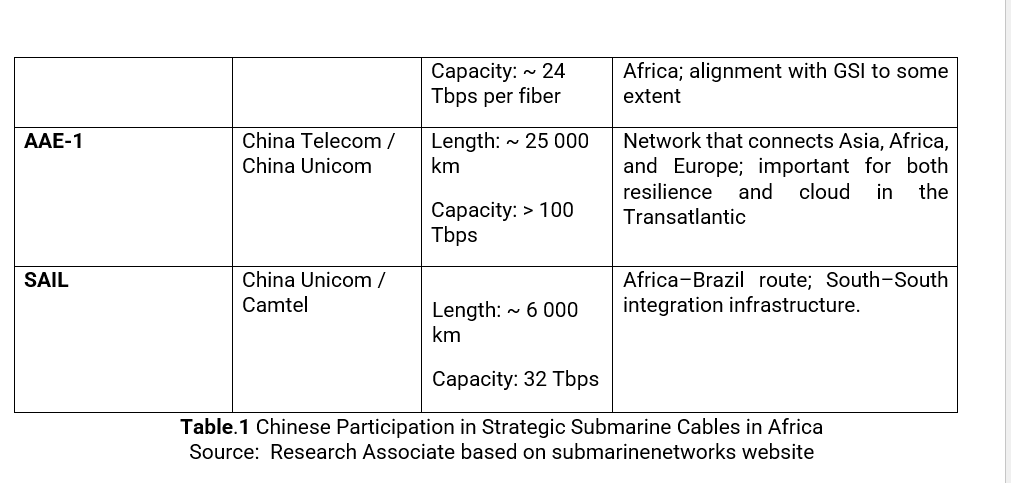
In this context, through the Global Security Initiative (GSI), China aligns its strategy to emphasize the protection of critical infrastructure, security of transnational data flow, and digital risk management across Africa. Their major projects 2Africa, PEACE, AAE-1, and SAIL (Table 1) are located in East Africa (Kenya, Egypt, Mozambique, DRC), Central Africa (Cameroon), adding to that the SAIL case which is expanded across transatlantic routes connecting Africa to Brazil. The cables do not just serve as transit mechanisms but additionally, they are complementary to data centers, cloud platforms, and 5G, which allow China to install its technologies into the urban and industrial systems of Africa. This infrastructure is the backbone of the smart city services which include sensor networks, algorithmic video surveillance, automated traffic management, and intelligent energy systems. Thus, all of these services require high throughput and low latency.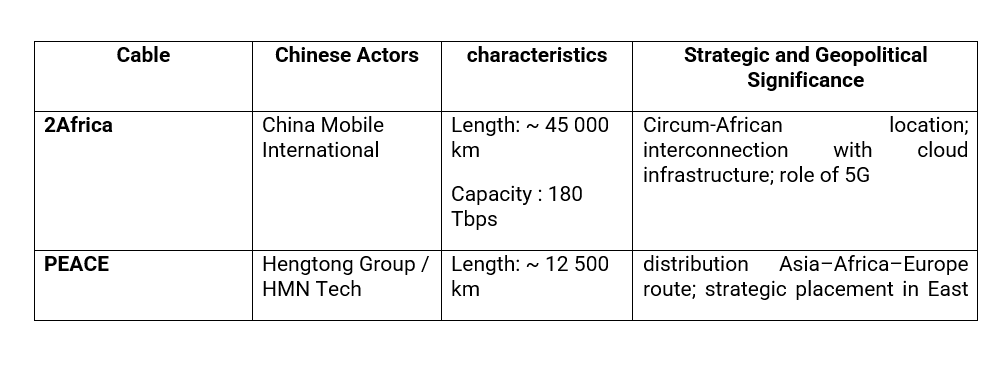
2.1.1. Global competition and Strategic Influence of China
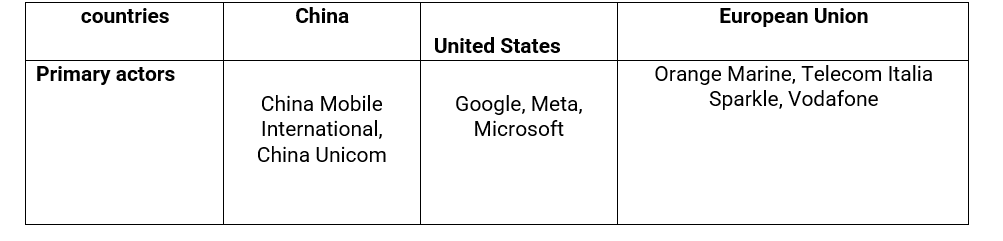
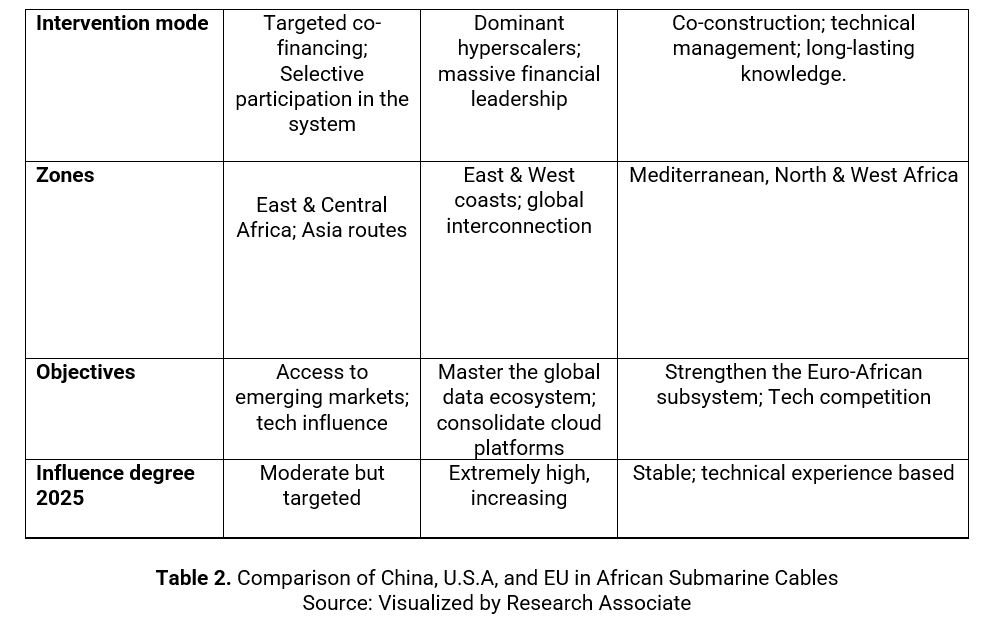
China’s expansion in African submarine cables takes an important place amid global power competition, which is quite active. The U.S., the European Union, and some non-Chinese Asian countries are all trying to influence the regions by securing communication corridors, setting cybersecurity standards, and using their power to control the situation. Key U.S. firms, especially hyperscalers, prefer using private or semi-open systems like Equiano that connect international cables, cloud services, and AI platforms. The European Union is embedding digital diplomacy through a mixture of financing, cable resilience initiatives, and support for “low-risk” vendors (digital-strategy, 2025) (Table 2). Japan, India, and other regional powers also back the consortia to protect the strategic corridors.
Africa therefore turns out to be the battleground of a conflict of values among the Chinese, American, European, and Asian governance models. The Chinese government highlights the aspects of accessibility, fast deployment, and technology integration, while the Western countries stress the points of trustworthiness, openness of regulations, and observing cybersecurity rules strictly.
In this regard, African countries act like judges between these different agendas according to their national interests: connectivity, sovereignty, route diversification, resilience, and the limitations imposed by finances. Thus, this forms a space for negotiation where states take advantage from global competition to get more favorable technical and financial conditions.
- Technological Duality and Strategic Functions
The analysis of this brief is based on SWOT methods to dissect the strategic positioning of Chinese Submarine cables introduced as a soft power tool in Africa, shedding light on operational strengths, crucial vulnerabilities, evident opportunities, and then recognizable threats from other global powers.
Strengths:
- Immediate and measurable enhancement of African digital potential through the deployment of large capacity systems like 2Africa, PEACE, AAE-1, and SAIL.
- The growth of digital markets, which attracts the implementation of 4G and 5G networks.
- Significant improvement in bandwidth capacity and lower wholesale data cost.
- Optimization of the operation of the data-intensive services, such as e-government portals, fintech ecosystems, and industrial IoT apps.
- Reinforcement of the position of countries that are located in the primary landing routes like Kenya, Egypt, Morocco, and South Africa as regional connectivity hubs.
- Acceleration of digitalisation in cities which allows more advanced traffic systems, surveillance architectures, and the automation of services to the masses.
Weaknesses:
- The dependence on a limited group of external stakeholders in building, repairing, and modernizing submarine infrastructure.
- Reduced agency of local authorities regarding infrastructure management, limiting the bargaining position.
- Interoperability issues, equipment certification, and overall longevity, particularly in situations where regulatory bodies are underdeveloped.
Opportunities:
- Leverage to economic integration at the regional level, and enhancement of redundancy for financial and government networks.
- Enable African nations to take advantage and benefit from competition between China, the United States, and the European Union, to have better financing, technical support, and regulating frameworks.
- Potential for improved financing, technical support, and regulating frameworks to increase the domestic digital market across the continent.
Threats:
- Geopolitical tensions can be a pressure to lock out some vendors and restrict equipment based on strategic inclinations of external powers.
- Integration of Chinese systems into local security, especially smart-city and surveillance infrastructure, raises possible interception and politicization of the infrastructure access in times of diplomatic tension.
- Physical vulnerability of submarine cables, which are liable to accidental damage caused by accidental cuts or intentional sabotage, especially around chokepoints like the Bab el-Mandeb, the Strait of Gibraltar, and the Mozambique Channel.
Conclusion
Africa’s digital landscape has changed as a result of the expansion of submarine cable infrastructure throughout the continent, especially with major Chinese involvement. This has made Africa a focal point in international technological and geopolitical competition. The repercussions of this changing infrastructure are manifold. African countries acquire the ability to use digital connectivity to drive industrialization, streamline public service delivery, and improve regional interconnectivity. However, the concentration of foreign actors, varied regulatory regimes, and disparities in cable distribution underline the importance for deliberate policy coordination. Ensuring resilience, sovereignty, and fair access necessitates policies that weigh the benefits of foreign investment against potential strategic concerns.
References
- Arnold, Stephanie. 2024. “Africa’s Roads to Digital Development: Paving the Way for Chinese Structural Power in the ICT Sector?” Review of International Political Economy 31 (4): 1148–72. https://doi.org/10.1080/09692290.2023.2297363.
- Benoît Pelopidas. 2004. “Joseph S. Nye Jr, Soft Power, The Means To Success In World Politics, New York, Public Affairs, 2004, 191 p. | Cairn.Info.” https://shs.cairn.info/revue-les-champs-de-mars-ldm-2004-2-page-II.
- Charity Maina, Evi Fitriani. 2025. “The Role of China’s ICT Investments and Strategic Communication in Enhancing Influence in Kenya | JPPUMA: Jurnal Ilmu Pemerintahan Dan Sosial Politik UMA (Journal of Governance and Political UMA).” https://ojs.uma.ac.id/index.php/jppuma/article/view/14261.
- digital-strategy. 2025. “Joint Communication to Strengthen the Security and Resilience of Submarine Cables | Shaping Europe’s Digital Future.” https://digital-strategy.ec.europa.eu/en/factpages/joint-communication-strengthen-security-and-resilience-submarine-cables.
- Esther Mwema and Abeba Birhane. 2024. “Undersea Cables in Africa: The New Frontiers of Digital Colonialism | First Monday.” https://firstmonday.org/ojs/index.php/fm/article/view/13637.
- Ministry of Foreign Affairs of the People’s Republic of China. 2023. “Global Security Initiative: China’s Proposal for Solving Security Challenges_Ministry of Foreign Affairs of the People’s Republic of China.” https://www.mfa.gov.cn/eng/xw/zwbd/202405/t20240530_11365534.html?utm_source=chatgpt.com.
- Mwema, Esther, and Abeba Birhane. 2024. “Undersea Cables in Africa: The New Frontiers of Digital Colonialism.” First Monday, ahead of print, April 14. https://doi.org/10.5210/fm.v29i4.13637.
- Ratiu, Andrea. 2021. “Cyber Defense across the Ocean Floor: The Geopolitics of Submarine Cable Security.” Atlantic Council, September 13. https://www.atlanticcouncil.org/in-depth-research-reports/report/cyber-defense-across-the-ocean-floor-the-geopolitics-of-submarine-cable-security/.
- Ross, Nancy, and Maggie Vencill. 2024. DIGITAL SILK ROAD PEACE: SUBSEA CABLE CONNECTIONS TO THE ICT.
- gov. n.d. “Joint Statement on the Security and Resilience of Undersea Cables in a Globally Digitalized World.” 2024. United States Department of State. Accessed November 25, 2025. https://2021-2025.state.gov/joint-statement-on-the-security-and-resilience-of-undersea-cables-in-a-globally-digitalized-world/.
- n.d. “2Africa – Submarine Networks.” Accessed November 25, 2025. https://www.submarinenetworks.com/en/systems/asia-europe-africa/2africa.
- Suneel Kumar. 2024. “China’s Digital Expansionism in Africa and the US Counter-Strategies – Suneel Kumar, 2024.” https://journals.sagepub.com/doi/10.1177/09750878231217957.
- Young Namkoong. 1999. “Dependency Theory: Concepts, Classifications, and Criticisms – Young Namkoong, 1999.” https://journals.sagepub.com/doi/10.1177/223386599900200106.
- French reference 2025. “La Confrontation Des Etats-Unis et de La Chine à Propos Des Câbles Sous-Marins | Ecole de Guerre Economique.” https://www.ege.fr/infoguerre/la-confrontation-des-etats-unis-et-de-la-chine-propos-des-cables-sous-marins.


